

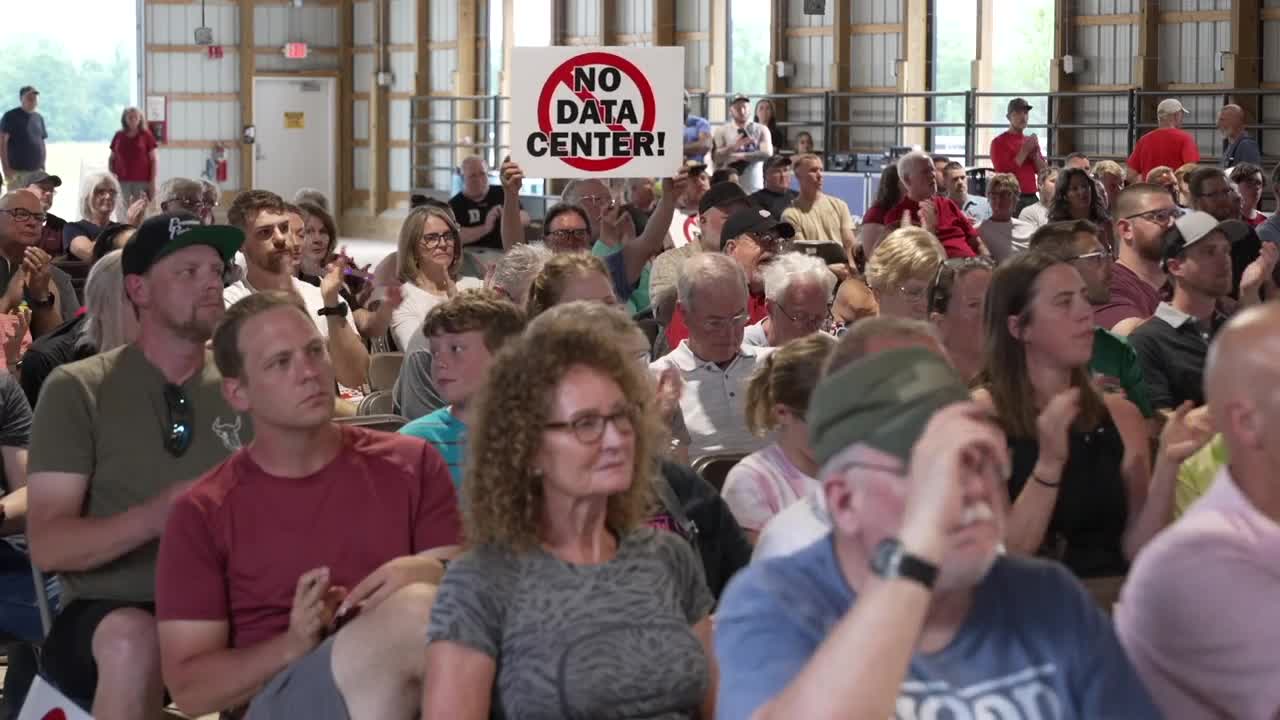


LOWELL, Mich. — Hundreds of neighbors packed a Lowell Township Planning Commission meeting Monday night as Microsoft presented details of its proposed data center campus, a project that continues to generate strong reactions from community members.
The meeting, which lasted nearly six and a half hours, included an almost hour-long presentation from Microsoft and roughly three hours of public comment. By the end of the meeting, the planning commission had not made a decision on the company's rezoning application.
WATCH: No decision reached after lengthy Lowell Township meeting on Microsoft data center proposal
Microsoft is seeking rezoning approval for the proposed Covenant Business Park development near I-96. The proposal includes five data center buildings, a utility substation, an employee office building and additional supporting structures.
During the presentation, Microsoft said it operates several hundred data centers worldwide and has experience working in communities similar to Lowell Township. Company representatives said the proposed campus was designed to protect environmental features, minimize light pollution, and would not increase electricity costs for nearby residents.
You can take a look at Microsoft's presentation slides below.
Microsoft Lowell Twp Proposal by WXMI
Despite those assurances, some neighbors say they remain concerned about the project's long-term impact on the community.
"We want to be pure Michigan. We love our lighthouses, our piers, our lakes," said Lowell Township neighbor Nicole Ronda. "This is the same reason Microsoft and all of these other data center companies are coming here, they want our water, despite what they say, despite what they want to promote."
Microsoft also highlighted the economic impact the project could have on the region. The company said development of the campus would occur over approximately 10 years, creating construction jobs throughout the buildout process.
Ryan Bennett, a Twin Lake resident and business manager for the Plumbers and Pipefitters union, said he supports ensuring local workers have a role in any future construction tied to the project.
"The way Microsoft became more transparent with data was very helpful," Bennett said. "If the community wants these things built, we want to make sure they're built with local residents and provide pipelines into the trades for these construction jobs that would be created."
Additional discussions about the proposed project are scheduled in the coming weeks.
A Planning Commission workshop is scheduled for June 22, where Microsoft representatives are expected to attend. A time and location have not yet been announced.
Microsoft is also expected to attend the Planning Commission's regular meeting on July 13.
Another Planning Commission workshop is scheduled for July 27, when representatives from Consumers Energy are expected to participate in discussions related to the project.
Microsoft has already purchased property in Dorr and Gaines townships for data center development, as municipalities across West Michigan place moratoriums on data center projects.
Data centers are large buildings filled with computer servers that store information and data — from videos and photos to Google and AI searches. The recent rapid rise of artificial intelligence has increased demand for data centers due to the computing power and energy needed to support the technology.
West Michigan has seen significant data center interest, but a major trend has been municipalities placing holds on any progress. The townships of Dorr, Zeeland, Caledonia, Cascade, and Solon have all placed moratoriums on data center development.
Some of those moratoriums are now approaching their end dates, including Solon Township, where farmland has been identified as a possible location for a data center. The Solon Township Planning Commission will discuss data centers later this month. The commission released the fifth draft of its zoning ordinance for data centers and set a public hearing for June 24 at Frost Creek Church.
Microsoft released a statement regarding the ongoing moratorium in Dorr Township.
"Microsoft is proud to be part of the Dorr Township community, and stands in full support of this measure to ensure any datacenter, including our own, is developed responsibly and strengthens, rather than strains, the community; and we look forward to continuing to engage with Township leaders and community members and incorporating their feedback into our plan."
In a separate statement addressing updated rezoning applications in Gaines and Lowell townships, Microsoft said:
"As part of Microsoft's commitment to being a good neighbor in Gaines Charter & Lowell Charter Township, the updated rezoning requests we have submitted for our data center projects include binding commitments to forgo property tax abatements so that tax revenue directly supports local schools, roads, and emergency services, pay our fair share for electricity and infrastructure upgrades, and utilize water-efficient designs; we look forward to continuing our work with local leaders and community members throughout this process."
The push for data centers in Michigan began in 2024 when state lawmakers gave companies sales and use tax exemptions as part of an attempt to recruit data centers to the state.

Kent
What's with the data centers? A discussion on the proposals in Kent County.
At the state Capitol, legislation has been introduced to establish a one-year moratorium on all data center projects, developments, and plans in Michigan. A series of 3 bills would halt all projects to give neighbors, lawmakers, and businesses time to learn more about the potential impacts. Those bills were referred to a Senate committee. In February, a similar series of 3 bills were also introduced in the state House and are also in committee.
Last week, leaders broke ground in Saline Township on Michigan's largest ever investment — a $16 billion data center campus for Oracle and OpenAI. The facility has been nicknamed "The Barn" for its design and is expected to be the largest data center in Michigan by both power capacity and physical size.
This story was reported on-air by a journalist and has been converted to this platform with the assistance of AI. Our editorial team verifies all reporting on all platforms for fairness and accuracy.

