

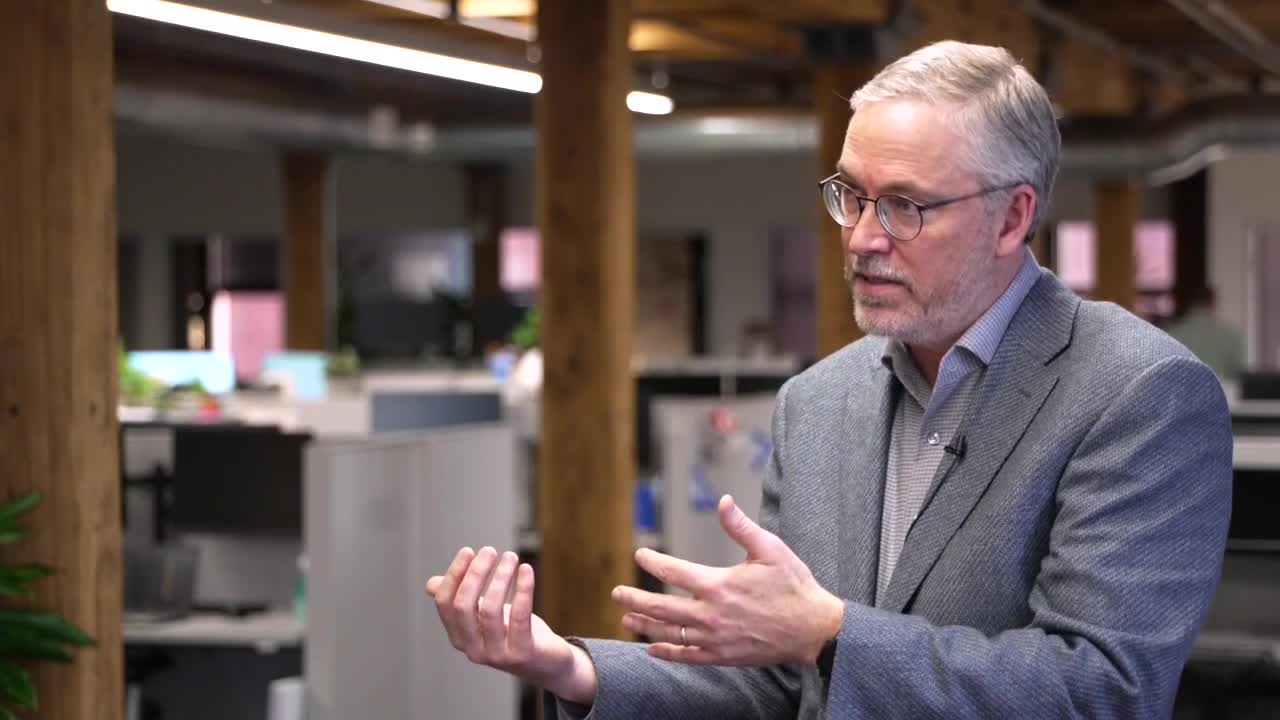



KENT COUNTY, Mich. — This winter in Kent County, data center proposals have popped up like wildflowers in the spring. The push isn't perennial, though, as a combination of political, technological and geographical factors have only recently opened the door for investment.
In a one-on-one interview with Randy Thelen, the president and CEO of The Right Place, I discussed these things and how his Grand Rapids-based economic development agency has worked to recruit trillion-dollar tech companies to the county.
The following questions and answers have been condensed for brevity and clarity.
What is a data center?
"Everybody uses a data center at some point during their day," said Thelen, mentioning social media, streaming, online banking and the accessing of online medical records as activities often supported by a data center.
"Effectively, a data center is a big building full of computer servers that are storing the data from all those videos or photos you might be saving, or all the calculations or the queries you might be making through a Google search or a prompt for an artificially-intelligent chatbot."
Why now? What are the reasons behind the recent rush of data center proposals?
As compared to the rest of the United States, Thelen says Michigan "didn't really participate" in the data center industry until late 2024 when state lawmakers gave them sales and use tax exemptions as part of an attempt to recruit them to the state.
"Our tax policies were quite different than other states," he said. "Now that tax policy has been changed and these companies are looking for real estate that would make sense and communities that would make sense."
Thelen also says the recent, rapid rise of artificial intelligence has increased demand for data centers due to the computing power and energy needed to support the technology.
"People talk about an AI bubble, it's really more of an AI window," he said. "There's a window of opportunity that will close at some point, and these companies are really now jockeying for position."
"Our job at The Right Place is to bring opportunities forward, to look at the things we think make sense in a diverse economy."
READ MORE: The Right Place releases its three-year plan for West Michigan's economy
Why Kent County?
At the time of the publishing of this article, the Right Place has had its hand in data center proposals in Gaines, Lowell and Solon Townships, all of which are in Kent County.
Thelen says, compared to other counties in West Michigan, Kent County's electrical infrastructure is better suited to support data centers due to the prevalence of 345 kV lines, which is a type of high voltage power line.
In addition, as data centers require constant cooling, the area's colder climate allows companies to reduce energy use and save money.
In Kent County, are you working with any other townships to bring a data center to their community? What should people living in these places anticipate?
"I don't know," Thelen said.
"We're seeing communities across all across Michigan, all across the country, look at their zoning ordinances. By law, you can't have exclusionary zoning, but you have to find ways to manage and make sure [a data center] aligns with your community."
What role does The Right Place play in recruiting data centers to Kent County?
After Michigan changed its tax policy regarding data centers, Thelen says tech companies have "constantly" called his agency in search of property for development.
"These are great companies, right? Microsoft is a great company," he said, referencing the tech giant that has purchased property for the potential data center in Gaines Township and revealed itself as the company behind the proposal for Lowell Township.
The Right Place then connects these companies to local elected officials and works to see if the company's proposal can align with the city or township's plan for the future, including whether these communities are willing to amend their zoning ordinances to accommodate a data center.
"Ultimately, the companies are deciding if they want to buy the land or not and the communities are deciding if they want to rezone the land or not," Thelen said. "That's the process we're going through right now.
How do you respond to public pushback?
During our interview, I read to Thelen a trio of criticisms against data centers, direct quotes from Kent County residents who, for a variety of reasons, don't want them built.
"I think a lot of us need to know who is going to be our neighbor," a woman from Lowell Township said.
"I think I would probably move if they put a data center [in my backyard]," a man from Solon Township said.
"They waste our water. They scare our wildlife," a man from Gaines Township said.
After hearing these quotes, Thelen said he and his agency are "taking them seriously" and responding to questions "as best we can."
Regarding concerns about power and water supply and light and noise pollution, Thelen said he and the tech companies who want to invest in the county are "hearing" them.
"Right now, we're in this awkward moment where the companies are trying to do their best to respond to community needs or community concerns, but it takes time."
This, Thelen said, has been cause for delays in the development process.
In December, Lowell Township said it was putting on hold a rezoning request that would have paved the way for a data center, citing a desire for "more specific details" about the project. A month later, Microsoft identified itself as the company behind the proposal.
Then in February, the tech giant asked for a delay in the development process for its data center proposal in Gaines Township, wanting to revise its rezoning request and time to respond to the concerns of the community.
In Solon Township, the board recently put a six-month moratorium on new data center proposals.
Thelen says this is "perfectly fine."
"These are great companies," he said. They're not looking to be bad neighbors. I just think they got off on the wrong foot. We've got to find a way to have an open conversation about the pros and the cons."
A number of people have been critical of the NDAs signed by local officials as part of the planning for these proposed data centers. How do you respond to concerns about a lack of transparency?
"The companies have have the right to go find property," Thelen said. "They have the right to figure out if a community is one they want to consider without disclosing their name."
"That's it," he said. "There's no negotiation that takes place behind the scenes. Certainly, there are no decisions that can be made behind the scenes."
"This sort of sausage making process we're observing is the process. It is very public. It's very transparent."
Do you feel as if you or these companies have overplayed your hand in terms of the number of data center proposals we've seen in Kent County?
"I don't know if it's the frequency as much as it's the size and scope," Thelen said.
If you look at the list of concerns, it's environmental, it's electric usage, it's water usage, it's noise, it's light, it's community impact," he said. "That's a little bit more subjective, right?"
"It's the subjective piece, the suddenness of the change and the size of the change that I think is sort of an under current of the concern, and that's something that has to be considered."
How do you convince people to consider this change?
"We have had incredible economic success in West Michigan because of our diversified economy," Thelen said. "Tech is a fast growing sector and we haven't fully participated in it and, in the near-term, data centers are the biggest wave of investment."
"The question for our region is, do we want to participate?"
For a billion dollar investment, Thelen says a data center could generate around $30 million a year in the property taxes it pays to a township or city.
"That's firefighters, that's the library, that's the local museum, that's the zoo, that's the school district," he said.
"There's opportunities, there's benefits to these things, we have to weigh those against the concerns and make an informed decision."


