



You've probably heard someone say during the summer, "It's not the heat, it's the humidity." And, they're kind of right.
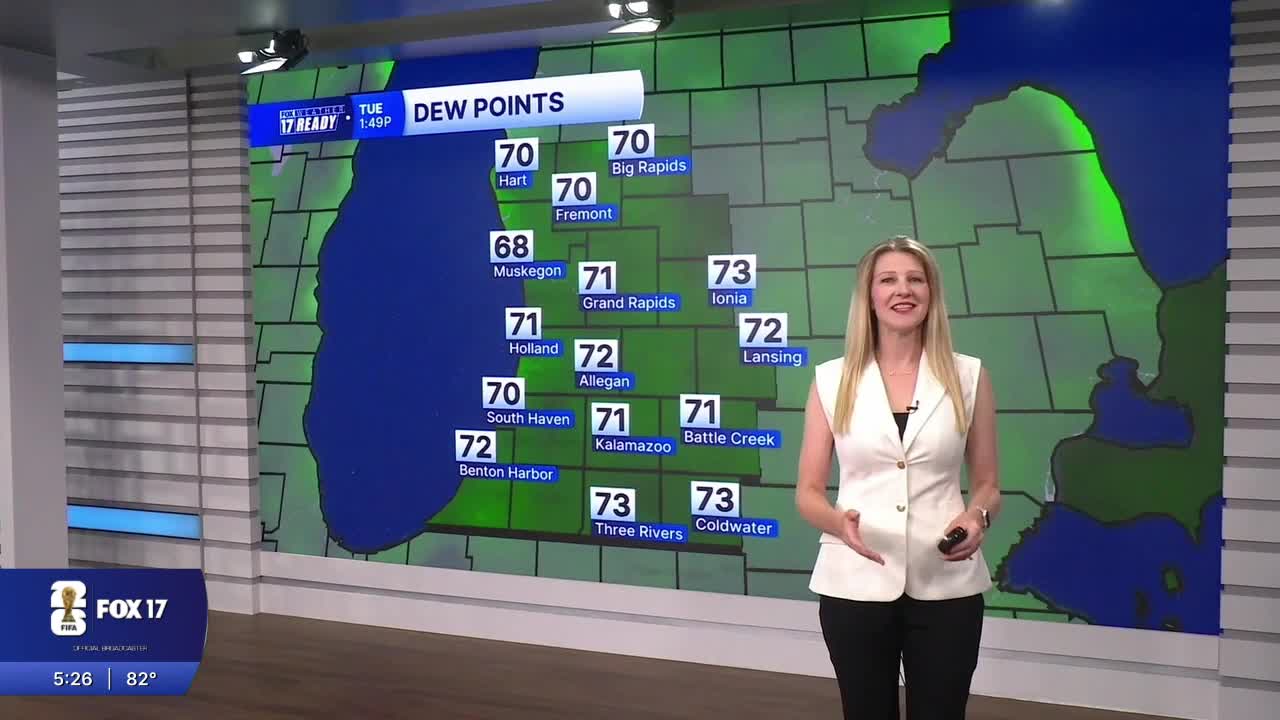
Both temperature and humidity factor into the "feels like" temperature — also known as the heat index. Think of the heat index as summer's version of wind chill. Instead of wind being the main factor, it's moisture levels, which meteorologists measure using dew point.
The higher the dew point, the more water is in the air — and the more humid it feels.

For West Michigan, once the dew point climbs above 60, conditions become noticeably sticky. When dew points reach the 70s, it feels more like Florida or the Gulf Coast.
Add in temperatures in the 80s and 90s, and heat indices can rise into the upper 90s and 100s.

Calculating the exact heat index value involves a long, complicated equation — but here's why it matters.

In humid air, it's much more difficult for sweat to evaporate off the body. Sweating is how the body regulates temperature. When sweat can't evaporate as easily, it becomes easier to overheat — and overheating can lead to heat exhaustion and, in extreme cases, heat stroke.
To stay safe, drink plenty of water. If you work outside, take frequent breaks in the shade and in air conditioning when possible.
Understanding the heat index can help keep you and your family safe this summer.

HEAT EXHAUSTION VS. HEAT STROKE
HEAT EXHAUSTION is when the body's core temperature rises into the low 100s (but below 103) as a result of a severe loss of water and salt, usually from sweating and prolonged expsoure to heat and humidity. Most of the time heat exhaustion can be treated at home or in an air conditioned location where a person can cool down and drink water or a sports drink with electrolytes.
Symptoms include extreme sweating, pale or clammy skin, dizziness, headache, and nausea. If symptoms do not improve within 30 minutes, seek medical help.
HEAT STROKE is a severe, life-threatening heat illness that requires immediate medical attention as the body's cooling system shuts down. People experiencing heat stroke have a core temperature higher than 104 and hot, dry skin. Additionally, it is likely a person will develop changes in their mental state (confusion, slurred speech, seizures) and possibly pass out.
If you suspect someone is having a heat stroke, call 911 and try to cool the person down with cold towels and ice packs before help arrives.
This story was reported on-air by a journalist and has been converted to this platform with the assistance of AI. Our editorial team verifies all reporting on all platforms for fairness and accuracy.
Want alerts when inconvenient or severe weather is headed your way? Download the FOX 17 Weather app and set up notifications for where you live.
For the latest details on the weather in West Michigan, head to the FOX 17 Weather page.
Follow FOX 17: Facebook - X (formerly Twitter) - Instagram - YouTube
