



GRAND RAPIDS, Mich. — One week before the August primary, four candidates competing for governor are weighing in on one of the most contentious issues facing West Michigan communities: data centers.
Perry Johnson and John James are competing in the GOP primary. Chris Swanson and Jocelyn Benson are competing for the Democratic nomination.

I sat down with all four candidates to get their take on data centers — a topic that has drawn significant community concern over proposed plans in West Michigan neighborhoods.
While some see data centers as a potential source of job creation and revenue for local governing bodies, West Michigan has also seen town halls packed with neighbors raising concerns about rising utility costs, noise pollution, environmental impacts, and a lack of permanent jobs. In Lowell Township, several members of the trustee board face recall petitions over a proposed Microsoft data center.
Gov. Gretchen Whitmer has proposed that all companies wishing to build a data center in Michigan must pledge to cover utility costs, commit to protecting the environment, and provide good-paying jobs to residents.

I sat down with the candidates to get their take on how they would handle the growing debate over data centers.
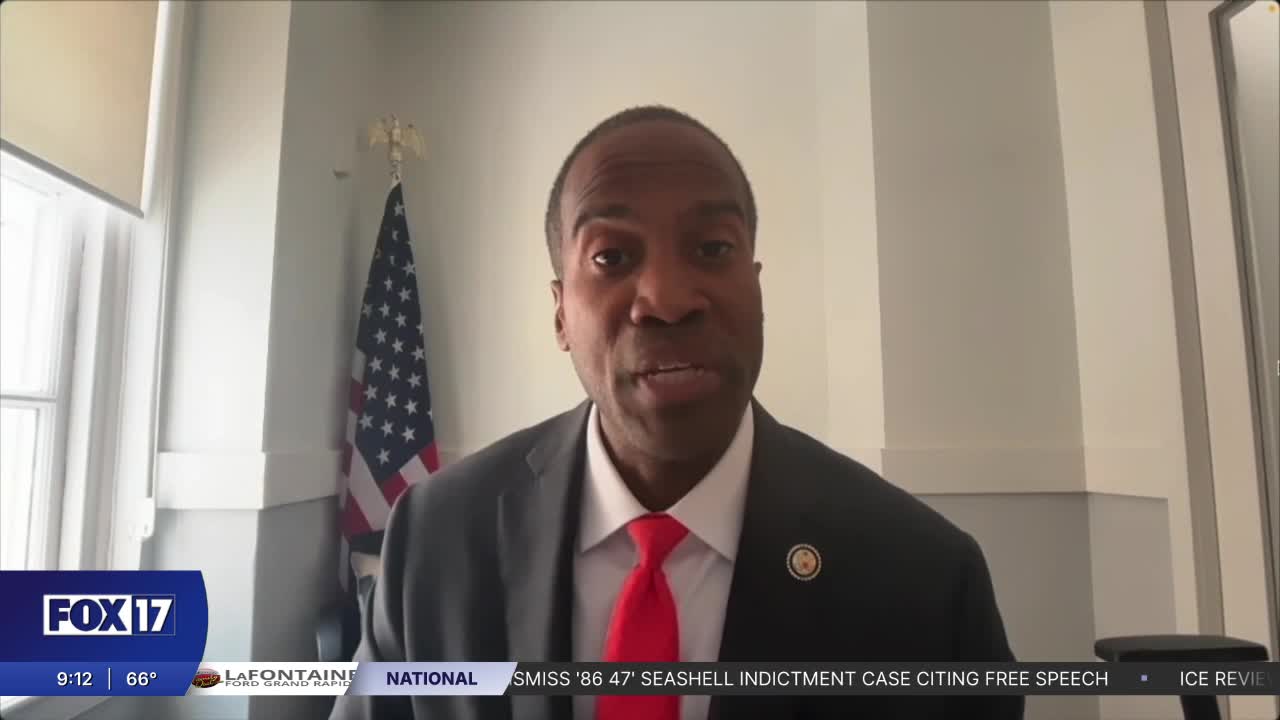
Republican candidate John James said Lansing should not be dictating to local communities.
"What would you do in that proposal to ensure that Michiganders aren't paying more when those data centers come in? Yeah, first Lansing should not be dictating to locals. No new data centers until we have a plan to protect our people," James said.

James also addressed land use priorities.
"We need to make sure that we're using the blighted brownfields that we already have before someone paves over productive green farmland. I'm going to be working to repeal PA 233. That's Gretchen Whitmer's essentially deal, or she removes local control so she can pave our productive green farmland with solar panels and wind farms," James said.
Republican candidate Perry Johnson called for a pause on new data center construction.

If we don't need these data centers in six and seven years, and we've built all these data centers and they're just sitting there at an eyesore, who is going to take care of remediating of cleaning them up? We don't have any provisions for that. So I had recommended a moratorium on data centers for one year to evaluate what goes on, I do not like leaping into things without knowing the ramifications, and that's exactly what we've done," Johnson said.
Democratic candidate Chris Swanson proposed a color-coded zoning framework for the state.

"Divide the state up in three colors: yellow, red, and green. Yellow means there's infrastructure and a baseline, and there's a desire for some kind of manufacturing or development. They're willing to talk. Cities, townships, counties, they'll tell you that. I met with the Michigan Municipal League. Communities know what they want and what they don't want. If it's a red zone, there's no infrastructure, or they don't want it, don't force it down their throats, which you're seeing in Saline. But a green zone means that they have infrastructure and they want business," Swanson said.
Benson called for statewide guardrails and a public information portal.

"I think the state has a really critical role of setting a statewide goal, statewide guardrails, and putting a moratorium in place that could protect every community statewide. Another thing I want to do to ensure residents have access to information about data centers coming to their communities is create a statewide portal so that anyone can see at any point who's looking to come to which community and be actively engaged and informed in making sure their voices are heard in those communities," Benson said.
Extended interviews with each candidate are available in the video player above.
