



WALKER, Mich. — Outside, a cold Michigan wind is howling.
Inside, there's a guy holding a knife coming at me.
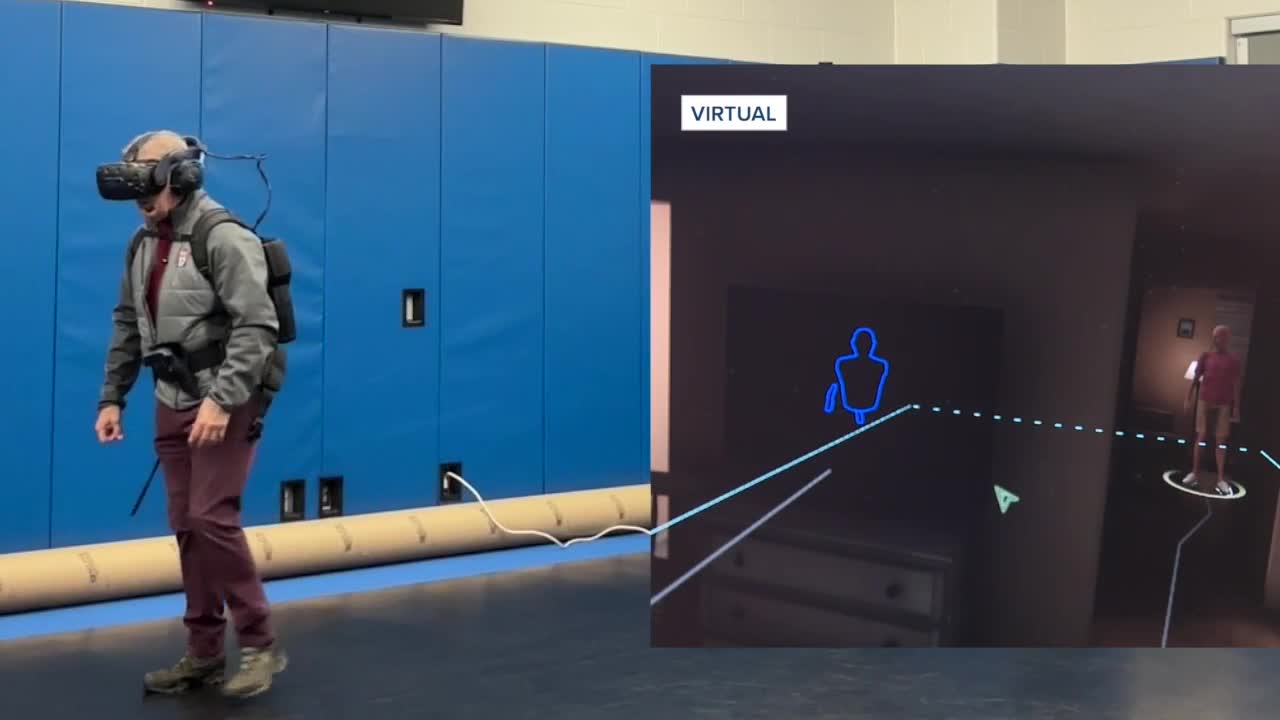
This is virtual reality training at the Michigan State Police District 6 headquarters training room.
The program launched in 2023, after MSP tested VR for decision-making scenarios involving individuals in mental health crises.
The response was overwhelmingly positive. So MSP bought 14 VR units, now strategically placed across the state. In 2023 alone, 1,700 people participated. To date, more than 3,000 people have done BR training at the State Policre Academy alone — not counting facilitators in the field.
How it works
Officers strap on a backpack computer and a VR headset.
A trained facilitator guides them through realistic scenarios — everything from clearing an apartment with an open door, to confronting a robbery suspect on the street.
The system rewards good instincts: active listening, communication, scene safety.
3 things trainees focus on
- Behavioral assessment
- Crisis communication
- Officer safety
MSP is pushing to bring community members, prosecutors, and community organizations through the training. prosecutors from surrounding counties recently participated — and loved it.
Traditional scenario training requires travel to the Academy, SIM rounds, paint rounds, and a full staff to run.
To compare, VR needs one facilitator.
Officers can run through a scenario, come out, watch the replay, talk through what they'd do differently — and go right back out on the road.
I went through two scenarios during the visit:
Scenario 1: Dispatched to an apartment with an open door — no one should be inside. Inside: a dark, ransacked room. A man with a knife.
Scenario 2: Responding to a gas station robbery. A suspect matching the description is right around the corner — hands seemingly free, but something in the waistband.
Both scenarios ended with the facilitator walking through what went right, what went wrong, and what a trained trooper would have done differently.
What's next
The VR equipment is evolving rapidly.
MSP is already eyeing next-generation systems — lighter, no backpack required, just the headset.
The software, designed by Michigan State Police in collaboration with doctors, includes 10 programs built specifically to address mental health encounters.
The mission stays the same: train smarter, communicate better, go home safe.
Do you have a story idea in Walker, Northview, or Comstock Park? Email robb.westaby@fox17online.com
This story was initially reported by a journalist and has been converted to this platform with the assistance of AI. Our editorial team verifies all reporting on all platforms for fairness and accuracy.
