

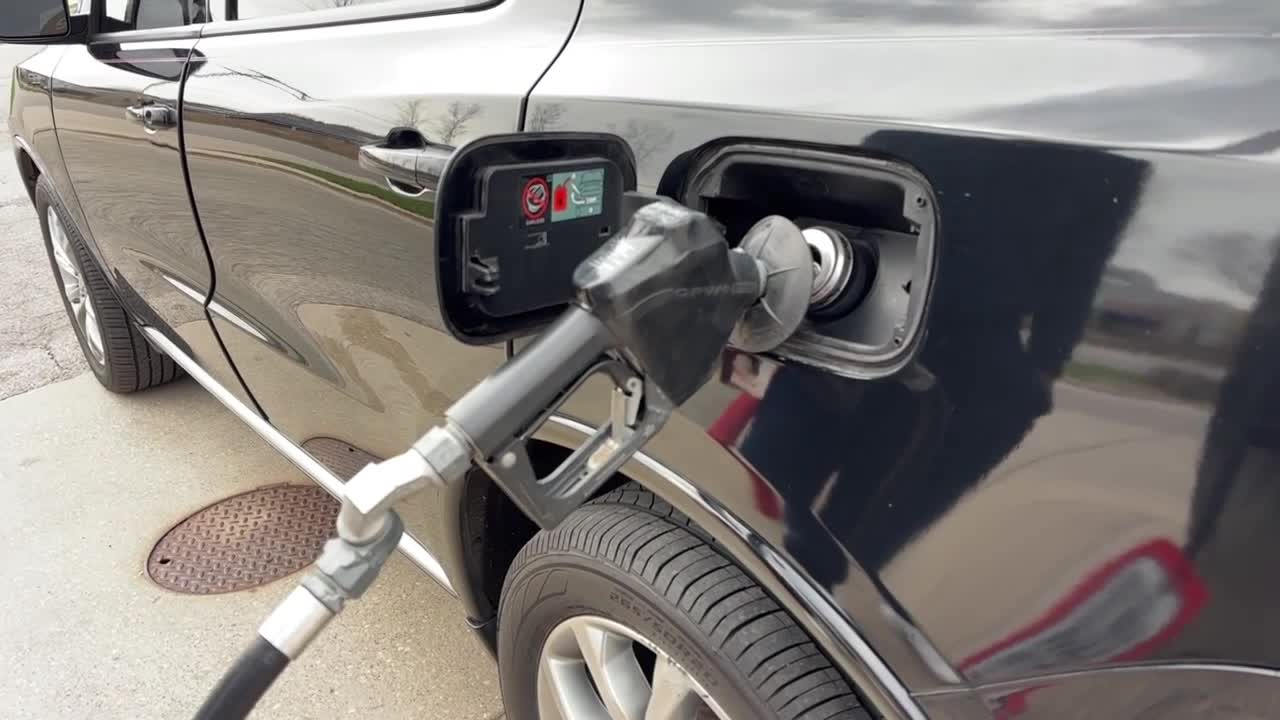


COMSTOCK PARK, Mich. — Delano Hinson pulls up to the gas station in his SUV, already calculating the damage. "It costs almost $80 to fill up my tank," he says, shaking his head. "It was around $60-65 before."
For Hinson, a medical transport driver who travels across Michigan, the price spike isn't just an inconvenience — it's threatening his livelihood. "The profit is almost not worth doing my own job, the way these gas prices are so high," he explains. "I already limited some of my jobs. I can't take all of them because the profit is not worth it."
His situation reflects a broader challenge facing drivers across the region. As a contractor who pays for his own fuel while receiving only mileage reimbursement, Hinson is caught in a squeeze between rising costs and static pay. "They only pay us by mileage," he says. There has been no adjustment for the higher prices.
The financial pressure is forcing difficult decisions. Hinson estimates that if prices continue climbing, "I'm just gonna have to eliminate my jobs." For now, though, he's adapting as best he can. "I haven't made any adjustments. I'm just going with the flow. It's out of my control."
Matt Long, who commutes from Grand Haven for work, echoes that sentiment of resigned acceptance. His two vehicles now cost dramatically different amounts to fuel: $80-85 for his car that requires premium gas, and $50-60 for his regular unleaded vehicle. "Definitely more conscious of it, for sure," Long says about his spending. "But I don't really have a choice. I gotta drive out here for work."
The psychological impact is as significant as the financial one. Long admits he's "definitely more conscious about just driving around town aimlessly" and is "doing that a little bit less, thinking about it a little bit more." Still, like many drivers, he sees limited options for major changes. "You gotta spend the money to get out there, right? It's kind of one of those costs you have to eat every time."
Some drivers are finding small ways to cope. Sherry Arraut, whose tank now costs $38 to fill instead of the previous $28, is "combining trips like going out for errands" and has "three or four places to go" in one outing instead of making separate trips. She's also become more strategic about where she fills up, carrying a 50-cent coupon to Meijer.
The broader economic picture adds uncertainty to an already stressful situation. According to GasBuddy analyst Matt McLain, the recent ceasefire in the Iran conflict initially caused crude oil prices to plummet, but the situation remains volatile. "If the ceasefire holds, then we're going to see prices fall. If the ceasefire doesn't hold, then we're going to go right back to where we were," McLain explains.
The timing couldn't be worse. McLain notes that fuel demand typically increases as spring arrives and people begin traveling more. "That's where we're going to be looking at a situation where the fuel demand should, in theory, begin to increase," he says.
For drivers like Hinson, who regularly travels as far as Traverse City for work, the uncertainty is particularly challenging. A typical job might require "an hour and 12 minutes" each way to St. Johns, Michigan — "two hours and 24 minutes for a round trip." With jobs scattered across the state, he can go through a tank of gas quickly, making every price increase a direct hit to his bottom line.
Despite the financial pressure, most drivers interviewed said they haven't identified a specific price point that would force major behavioral changes. As Long puts it: "You gotta grow up and deal with it." For many, that means continuing to drive, continuing to pay, and hoping prices eventually come down.
This story was initially reported by a journalist and has been converted to this platform with the assistance of AI. Our editorial team verifies all reporting on all platforms for fairness and accuracy.
