



GRAND RAPIDS, Mich. — At the base of a tree on Nelson Avenue, a memorial, somewhat muddied by spring showers, still remembers the life of Patrick Lyoya.
On Saturday, four years will have passed since Lyoya was shot and killed by Christopher Schurr, a now-former officer with the Grand Rapids Police Department. The two had been struggling over Schurr's taser during a traffic stop on the city's southeast side when Schurr shot Lyoya in the back of the head. Schurr was charged with second-degree murder and, last spring, his trial ended in a mistrial when the jury was unable to reach a unanimous verdict. Shortly after, Kent County Prosecutor Chris Becker announced he would not to retry the case.
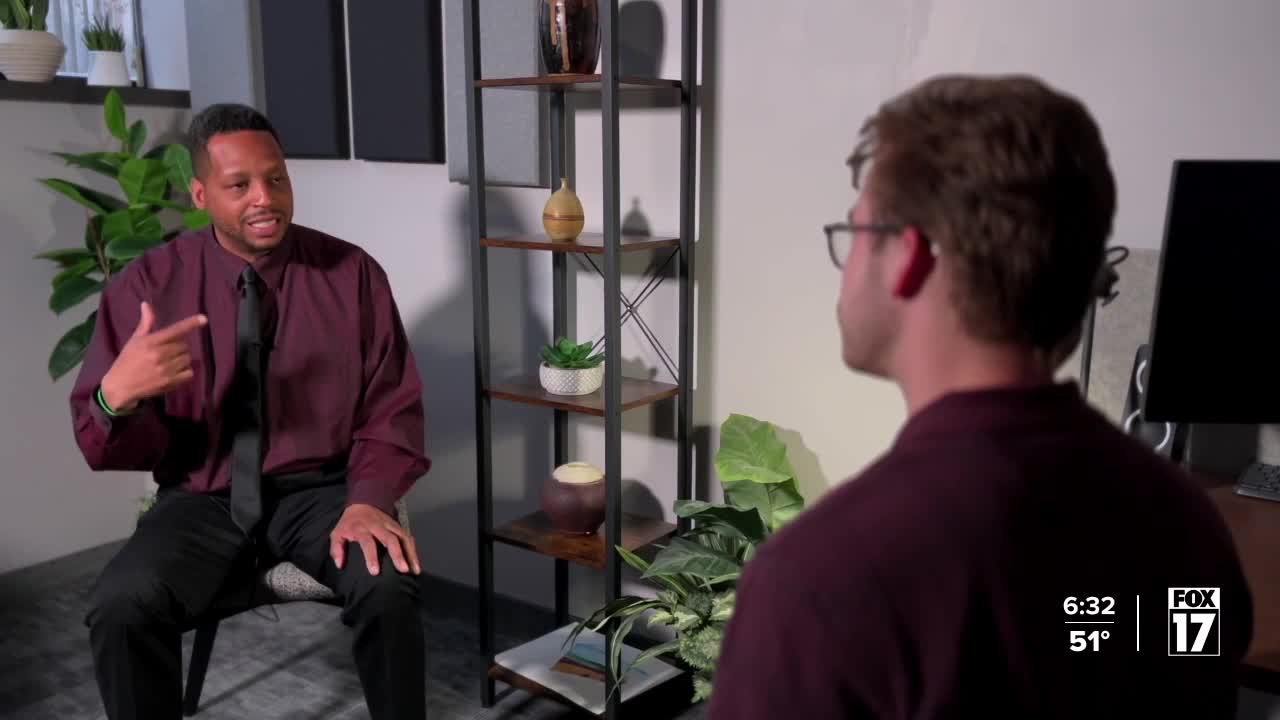
When Wayne Butler passes by the collection of teddy bears, flowers and candles that mark the area of Lyoya's death, he thinks about what he witnessed that rainy morning in April.

"The situation was fixable," Butler said. "What plays back in my mind is what everybody could have done in the situation so Patrick could be alive and also so Officer Schurr wouldn't have to go through what he had to go through."
What Butler witnessed, he also testified about during the trial.

Shooting death of Patrick Lyoya
'This is how it ends every time:' Witness testifies in Schurr trial
On April 4, 2022, Butler said he was getting ready for work when he saw the lights of Schurr's patrol car from inside his house. Then, when a "tussle" between the officer and Lyoya spilled into his front yard, he stepped outside.
As a black man, Butler said he felt he could reason with Lyoya and tried to get him to comply with Schurr, who was attempting an arrest.
"I was talking to Patrick. I was just telling the man, 'Come on. I know it might not be your day, man, but you got to stay down to live,'" Butler said as part of his testimony.
"In America's history, this is how it ends every time," he said at the time.
During our interview, I asked Butler about this statement.
"You don't comply, you die, if you're black and a male," he told me. "We can complain about the rules, or we can just play to win, and so you just listen to the police. If you're black in America and want to live and want to live a prosperous life and be a contributing American, that's it."
Butler did not see the moment when Schurr fired his gun as he had gone back inside to grab his phone so he could film the struggle.
He still wonders if he could have prevented Lyoya's death if he had stayed outside, if he had done something differently.
"When something out of the blue comes to you and it's directly at your doorstep, it's for you to handle the right way," he said. "That's the five percent that I play back in my brain, trying to figure out, 'God, what could I have done a little bit better to make everybody's life a little bit better?'"

Four years later, the "five percent" is what Butler still carries with him. He still lives on Nelson Avenue and, whenever he passes by the memorial, is reminded of this call to give "a little more" to those around him.
This testimony to Lyoya's life, he adds, is kept up by a neighbor of his, whose driveway is shoveled every winter by another neighbor who lives on the street.
"There's these communities that exist in America, all over America, and that's the real story," he said. "Hopefully these moments that we are apart of will allow us to realize what we all could have done better, and it brings us together just a little bit closer as Americans."

What's changed?
Prior of the four-year mark of Patrick Lyoya's death, I reached out to the City of Grand Rapids and the Grand Rapids Police Department about policy changes that have been enacted since the deadly shooting.
"The City of Grand Rapids and its Police Department remain committed to continuous improvement so we can better serve all who live, work and visit our community," a city spokesperson said in part on behalf of the city and GRPD.
"This means we regularly review and strengthen our policies, procedures and practices. We do so with community input, expectations and trust at the center of our work. We will continue to look for new opportunities to improve public safety and strengthen our relationships with residents."
Continuing, the spokesperson named a number of changes brought to the police department and city over the past four years, adding the measures "were not implemented in response to the officer‑involved shooting incident four years ago" but reflective of "the many steps we have taken to enhance policing, accountability and public safety."

Grand Rapids
City leaders in Grand Rapids review ten officer-involved shootings
A list of recent policing-related policy changes at GRPD/City of Grand Rapids, per a city spokesperson:
- Increased citizen-informed and citizen-engaged co-created and co-experienced training.
- Transitioned subject-control tactics from striking-based to grappling/Jiu-Jitsu-focused methods.
- Added automatic shut-off safeguards to TASERs and enhanced body-worn camera reliability.
- Increased immigrant outreach efforts through the Office of Oversight and Public Accountability (OPA) to strengthen police and community relations.
- Expanded less-lethal tools and modernized psychological evaluations to include enhanced bias screening.
- Launched and expanded the Mental Health Co-Response Team over multiple years with added social workers.
- Strengthened the Victim Services Unit, including hiring a civilian Victim Services Manager.
- Expanded OPA’s Clean Slate GR expungement program serving hundreds annually.
- Expanded youth programs including the Civil Rights Youth Academy, Law Day, and Know Your Rights education.
- Expanded summer youth evening programming through a partnership with OPA, Our Community's Children, and community organizations.
- Expanded community policing and education initiatives, including enhanced social media outreach.
- Implemented systemwide initiatives to embed racial equity in GRPD and GRFD policy evaluation and data analysis.
- Formed the Police Chief Advisory Committee and Clergy on Patrol.
- Implemented major updates to de-escalation, response-to-resistance, and use-of-force policies, including a formal sanctity-of-life provision.
- Reported on surveillance policy in partnership with the community to ensure transparency when using video technology.
- Reemphasized foreign nationals policy to ensure policing is done prioritizing safety over status.
- Increased disciplinary record retention period from two to four years through collective bargaining.
- Increased OPA contractual rights to records through collective bargaining.
- Adopted BlueTeam software for improved use-of-force incident tracking.
- Maintained CALEA accreditation, affirming alignment with national best practices.
- Implemented the GRCC Police Recruit Academy partnership to diversify and modernize police training pipelines.
- Expanded recruiting efforts to improve diversity, including outreach at HBCUs, military bases, and local colleges.
- Civilianized several sworn positions through collective bargaining.
What about Christopher Schurr?
In the months that have passed since his second-degree murder trial, Christopher Schurr has "done his best done his best to return to a normal routine," according to Matt Borgula, the attorney who defended the former officer in court by arguing the deadly shooting was an act of self-defense.
"However, that routine will never be the same," Borgula said. "He lost the job he loved helping the community as a police officer, and he continues to face a civil lawsuit."

Shooting death of Patrick Lyoya
SCHURR TRIAL: Grand Rapids police captain says former officer acted reasonably
I asked Borgula for his thoughts on how, if at all, the shooting changed the City of Grand Rapids and its people.
"I think the trial led to further division in the City of Grand Rapids," Borgula said. "I hope our community leaders will work with the GRPD and the County Prosecutor to ensure that the City is safe for all residents and that our justice system is fair for everyone, including police officers."
"I also hope that the legislature will finally address the legal gap that creates uncertainty for police officers and prosecutors regarding when a law enforcement officer can be charged with a crime for using deadly force, as opposed to a civilian."
As mentioned by Borgula, a civil lawsuit filed against Schurr by the family of Patrick Lyoya is set to begin in the fall.


