

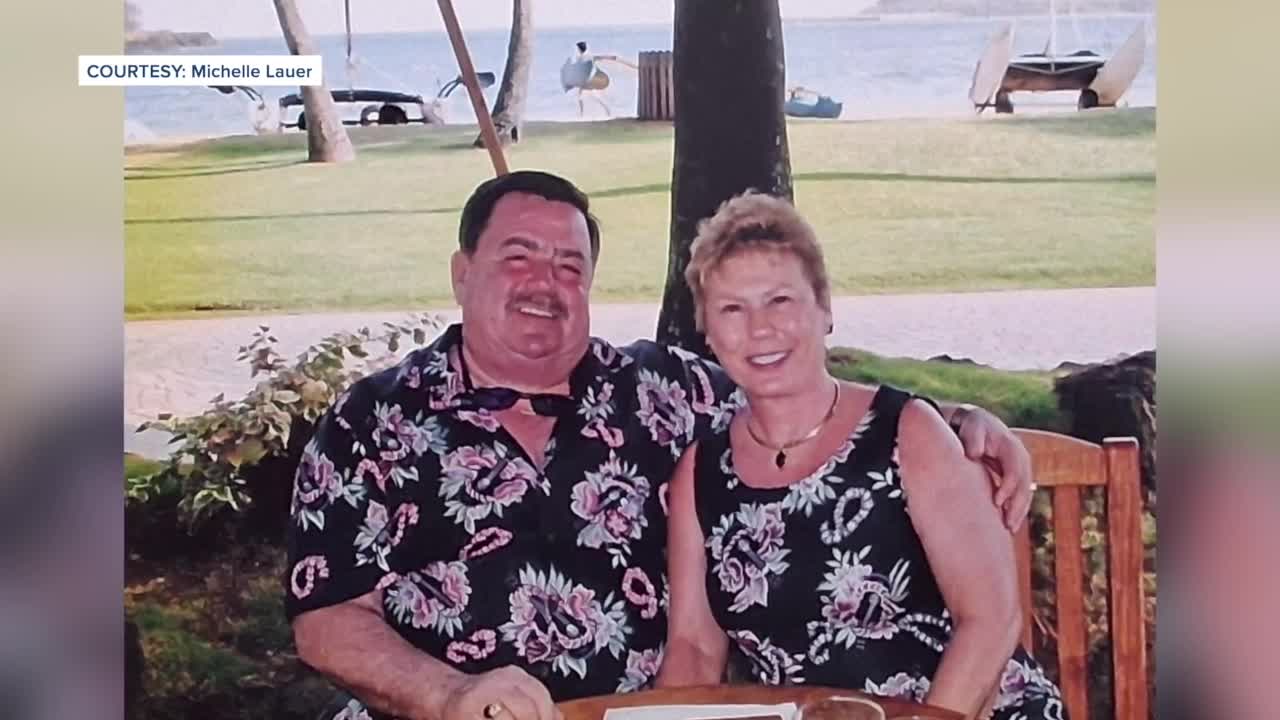


CASCADE TOWNSHIP, Mich. — After losing her mother to lung cancer, Cascade neighbor Michelle Lauer discovered dangerous radon levels in her parents' home. Now she's sharing her story to warn others about a risk many people don't realize could be inside their homes.
Lauer describes her mom as someone who was always thinking about others.
"When I was going through her things, I found two things that really speak to who she was. One was a prayer journal, so she would pray for anybody that wanted prayers, and she would keep track of all of them," Lauer said.
A Sudden Health Crisis
Nothing pointed to what was coming. While driving back from Key West to St. Petersburg, her father noticed a change.
"It's a terrible story. So my mom and dad were retired, and they traveled a lot and driving back from Key West to St. Pete, my dad noticed that my mom had a really visible change in her behavior, so he though she was having a stroke," Lauer said.
When they rushed her to the emergency room, doctors found a tumor in her brain caused by lung cancer that had metastasized.
WATCH THE VIDEO STORY
The Search for Answers
Her mother had quit smoking 35 years before her diagnosis. Her oncologist considered her a non-smoker and told the family smoking was not what caused her lung cancer.
"She was considered a non-smoker, and we know from the radon levels that I tested that they were very high," Lauer said.
After both her parents had passed, Lauer noticed a radon system label in the basement but didn't hear a fan running. She bought a test at a big box store, and the results came back at high levels.
Understanding the Silent Killer
Matt Andrews, owner of SM Radon, explains what radon is.
"It is a naturally occurring cancer causing radioactive gas that can be found in any home," Andrews said.
You can't see, smell or feel radon. According to Glenn Thompson III, supervising sanitarian in the Environmental Health Division with the Kent County Health Department, it's the second leading cause of lung cancer in the United States, responsible for approximately 21,000 deaths each year. For non-smokers specifically, it's the number one cause of lung cancer.
Thompson says radon forms naturally from the breakdown of rocks and soil, and can also be found in water and construction materials.
For more information about radon, click here.
Testing and Prevention
Health officials say testing should be done at least every two years, though Andrews recommends continuous monitoring since levels can change with weather and seasons.
"The winter months are actually the best time for testing. You want to try to create, like a closed home environment so that we're not getting influences from the outdoor air," Thompson said.
Testing can be done with short-term kits available at stores like Home Depot, or homeowners can hire a professional to test and mitigate their home.
If levels are high, a mitigation system can pull the gas from beneath the home and send it outside. Andrews says most systems in the region cost between $1,100 and $2,000, depending on the home.
A Mission to Save Lives
For Lauer, the goal is awareness.
"If one persons life can be spared, of having to deal with cancer, or be spared, you know, from passing away from cancer, it would be worth it," Lauer said.
She advocates for legislation requiring radon testing when homes change hands and encourages realtors to advise clients to test, since mitigation is relatively inexpensive.
Thompson says radon test kits are available year-round at the Kent County Health Department for $5, with free kits distributed during Radon Action Month in January.
This story was initially reported by a journalist and has been converted to this platform with the assistance of AI. Our editorial team verifies all reporting on all platforms for fairness and accuracy.

