

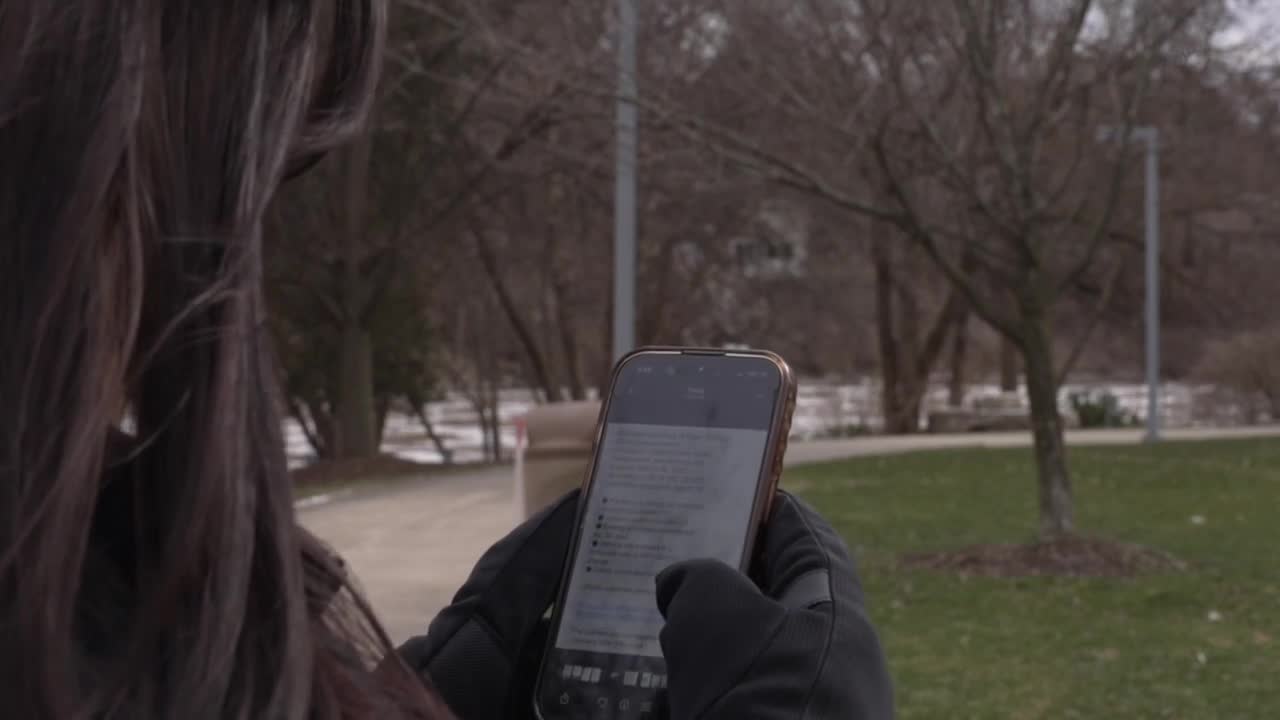


CASCADE TOWNSHIP, Mich. — A text message claiming to be from the Michigan Secretary of State is making the rounds — and officials say it's a scam.
The message reads: "Michigan Secretary of State Office enforcement notice: unpaid traffic ticket. Enforcement proceedings will begin on March 19, 2026 if the fine is not paid." It threatens driving violations and includes a link to what appears to be an official payment portal.
Cascade neighbor Tom Gottlick said the message raised immediate red flags.
"That's a huge flag when you see something like that," Gottlick said.
His concern isn't whether he would fall for it — but whether someone like his mother might.
"She was getting this repeatedly, saying that she had a toll booth violation for driving to Illinois," he said. "I said, it's a scam, but she was really panicked about it."
WATCH THE VIDEO STORY
A wave of government impersonation scams
Nakia Mills, Chief Marketing Officer for the Better Business Bureau of Michigan, said this kind of scam is part of a growing trend that traces back to the widespread toll-fee text scams that circulated roughly 18 months ago.
"The last year, maybe even two years, there has definitely been an uptick of these certain types," Mills said. "You might recall, maybe about 18 months ago, everyone was talking about the toll text scam, and ever since they started texting about toll fees, now there just seems to be variations of a text claiming it's from the government, and it usually threatens you in some sort of way."
Mills said the strategy is deliberate — scammers are engineering panic to make people act without thinking.
"Always remember it's trying to get that sense of urgency and fear. You think, oh my goodness, I don't want to have to pay more, so let me just hurry up and pay this," she said. "The scammers are constantly working on our fears and hoping we see something like this, and we act quickly without thinking."
Who is most at risk?
Contrary to what many might assume, Mills said younger adults — not older ones — are often more at risk of falling for scams.
"A lot of people think that older adults are more susceptible to scams. Actually, in our recent BBB scam tracker report, we found that young adults actually in that 18 to 24 bracket are more susceptible to scams," Mills said. "However, older adults, when they do interact with a scammer, tend to lose more money. So everyone really has to be careful."
Mills added that scammers tailor their approach depending on who they're targeting.
"Sadly, there's a scam for everyone. They just change their way of communicating to possibly reach you," she said.
Mills also recommends that parents and teachers talk to children about scam awareness early, noting that the BBB runs a program called Scam Busters that goes into high schools across Michigan to teach students how to spot scams.
"Even though we don't necessarily have the data showing when they're targeted, we do know it's happening," Mills said. "So we try to teach parents and teachers to make sure that they're teaching the young people what to watch out for at a young age, since we all are constantly connected now."
What to look for — and what to do
Mills says questionable links and unknown numbers are the biggest warning signs.
"Those questionable links are one thing that you always want to watch for. And then if you don't know the number, the same way we say, don't answer a phone call from someone you don't know — don't respond to that text," Mills said.
She also cautions against replying "STOP" to a suspected scam text, warning it can make things worse.
"If you reply 'stop' on a scam text, now you're just confirming with them this is a number that engages, so they might sell it to even more other scammers on the black market," Mills said. "So it's annoying, but yes, mark it as spam, block it, delete it. Do not engage. Please do not click on any links."
Mills says if you're ever unsure whether a government notice is real, don't respond to the message — take the initiative yourself.
"If you're not sure, just go to the real Secretary of State site, the real government site, and look and see if there's information about that, or give them a call," she said. "You do the outreach, instead of responding to some odd number that contacts you."
She added that legitimate government action typically doesn't arrive by text.
"It's very rare that you're going to just randomly get a text message from the state government telling you to pay this fine or else. Typically, you'll get a letter in the mail if there's some sort of government action against you," Mills said.
The Secretary of State has posted information online stating the office will never ask for money or personal information by text or QR code.
AI-powered scams are also on the rise
Mills says scammers are increasingly using artificial intelligence to make their schemes more convincing — including impersonating family members' voices to trick loved ones into thinking they've been kidnapped.
To guard against these types of scams, Mills recommends families create a secret passcode.
"If it's really me, here's our secret passcode. And that's helped a few people who've actually told us it worked for them," Mills said.
She also notes that while text scams are surging, email scams haven't gone away.
"We're all on our phones all the time, so scammers know that. But don't think that email is suddenly safe," Mills said. "If you don't know it, don't click it."
Report it
Mills urges anyone who receives a scam text to report it so others can stay informed.
"The best thing you can always do is double check, because sometimes people get these offers and they really believe it," she said. "The more we share, that's our best defense against scams."
The BBB offers a free Scam Tracker tool at bbb.org/scamtracker where residents can both report scams and search to see if others have flagged the same activity.
This story was initially reported by a journalist and has been converted to this platform with the assistance of AI. Our editorial team verifies all reporting on all platforms for fairness and accuracy.

