

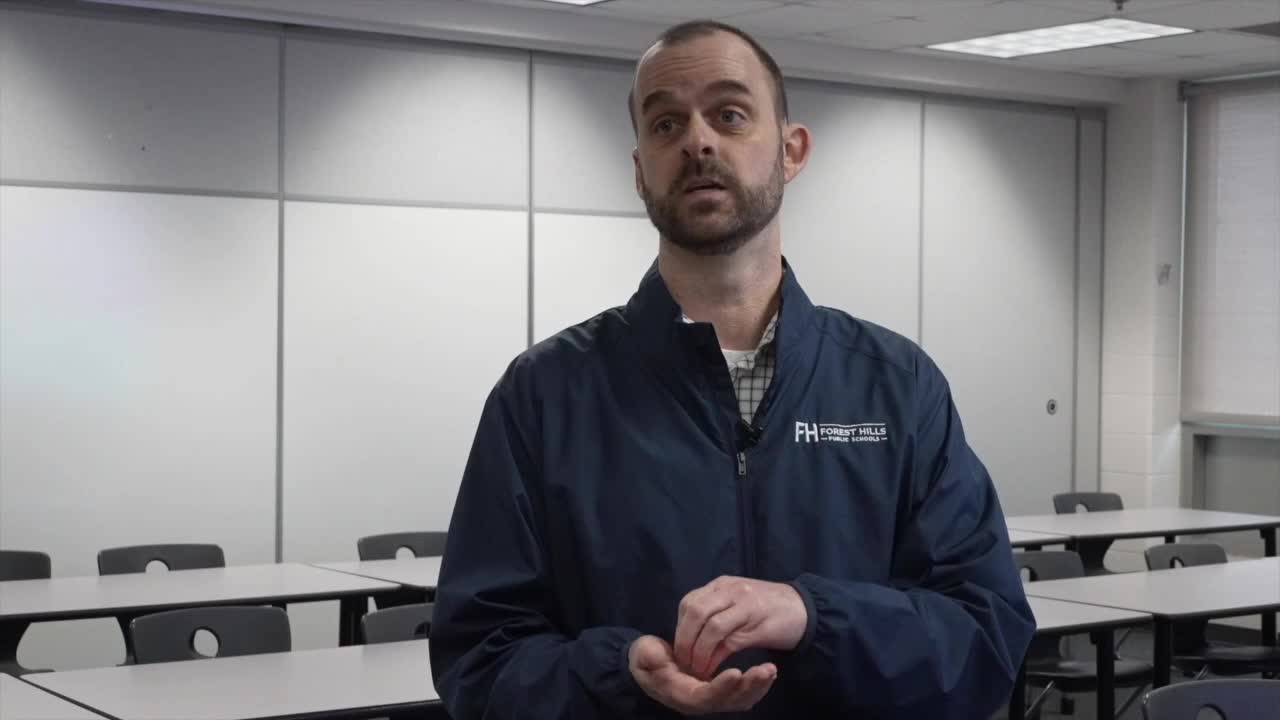


FOREST HILLS, Mich. — Educators at Forest Hills Eastern High School are teaching students how to use artificial intelligence as a tool — without letting it replace critical thinking or the human connection behind learning.
Students feel the pull of AI convenience
For students like Sophia Mahajerin, a junior at Eastern, AI has quickly become part of everyday academic life.
"I can ask it anything, and it'll give me an answer," Mahajerin said. "But I think one of the negatives is that I've become very reliant."
Using tools like Gemini, students can build study guides and organize their schedules. But that convenience comes with a trade-off, Mahajerin said.
"In order to really, truly learn something, you have to do it independently."
WATCH THE VIDEO STORY
The district builds a structured framework
Forest Hills Public Schools has taken a structured approach to address that concern. The district uses approved apps including Gemini, MagicSchool and Khanmigo, and has developed a rubric with a zero-to-four scale outlining when students should and should not use AI on a given assignment.
Aaron Romoslawski, the district's director of AI strategy and instructional innovation, a position created in January, said the rubric goes a step further than what other districts have implemented.
"What makes Forest Hills' rubric a little more unique than other districts is that it also includes a disclosure requirement, because we want to teach students how to cite and how to announce when they are using AI for different purposes, rather than just using it in the shadows and in the dark," Romoslawski said.
He said teachers are empowered to decide how and when AI is used in their classrooms.
"We allowed the teachers to decide when to push, when to pull, when to help students use AI, when not to use AI, because the biggest thing we're facing in education K-12 is there are foundational skills that we absolutely must be teaching," Romoslawski said.
A grade-by-grade approach to AI
The district also takes a step-by-step approach across grade levels. In kindergarten through fourth grade, teachers model AI use rather than having students interact with it directly. In middle school, students begin using tools like MagicSchool and School AI — platforms that allow teachers to monitor what students are submitting. By high school, students are given access to Gemini as part of a gradual release of responsibility.
Romoslawski said the decision to open Gemini to high school students came in part after a data review revealed students were already using unsafe AI sites on their own.
"Google provides us with a safer AI alternative through the education version of Gemini, which is why we opened it up," he said.
Teachers remain the most essential tool in the classroom
Romoslawski was clear that none of this changes the role of the teacher.
"AI does not replace teachers in their current form, in any way, shape or form," he said. "The students unanimously said they want to hear from their teacher and how they're doing in the class."
He noted the district learned that lesson firsthand during the pandemic.
"We tried already to go to digital lessons during COVID, and we really missed that human experience," Romoslawski said.
Setting clear expectations inside the classroom
Inside the classroom, theater, broadcast and English teacher Annie Hebel — who has been teaching for 34 years, 12 of them at Eastern — said she sets clear expectations from the start of every assignment.
"I let the students know immediately when I give an assignment, are we using it? Are we not, and if we are using it, this is what it looks like," Hebel said.
To hold students accountable, Hebel collects a handwritten writing sample from each student at the start of every semester. That baseline allows her to identify when a student's voice changes throughout the year.
"If there's any question, I go back to their basics, and I say, hey, this just doesn't sound like you," Hebel said. "And then I have those conversations with kids. So it's not punishable necessarily, and it's not punitive, it's definitely a conversation, and it's a tool for learning."
That structure has also changed student behavior. Hebel said she no longer sees students hiding their AI use when a teacher walks by.
"It's interesting that you say that, because I think in the last conversation, or maybe in the last question, you talked about kids hiding it, and kids, you know, closing a tab when the teacher walked by. Now, I'm not seeing that," she said.
Building tools to meet students where they are
Hebel said foundational skills remain a priority, even as AI becomes more integrated into her lessons.
"There are skills we need to teach. Kids need to know how to write a sentence, or they need to know how to write an essay," she said.
To better meet her students' needs, Hebel used AI to build classroom apps. The first, called Scholar's Companion, helps students navigate citation formatting without the clutter of ads or videos. The second, called Sparktivity, targets what Hebel describes as a growing problem she calls "digital amnesia."
"I would ask kids open-ended questions, and they didn't know how to answer them without looking at their computer," Hebel said. "So I created an app that helps develop those creative thinking skills — lots of ideas, lots of original ideas, taking two disparate ideas and bringing them together to create a new idea."
She said the results have been noticeable.
"Now, when I ask them open-ended questions, they don't go physically move to their computer to look up the answer. They can now look me in the eyes and have an open-ended conversation and give me some crazy, zany ideas that they never would have before," Hebel said.
The human side of education stays at the center
Even as technology evolves, Hebel said one thing remains constant.
"Relationships are key, right? Relationships with other human beings is key, and AI can't replace that," Hebel said. "AI is not human. AI is not creative. AI is just a machine."
Mahajerin said the school's balanced approach is already making a difference.
"I think what they've been doing is really helping," she said.
Preparing students for what comes next
Romoslawski said preparing students for the future is the ultimate goal — noting that workers with AI-related skills are already seeing a 23% salary premium in many job offers. With ChatGPT only having been publicly released in November 2022, he acknowledged the district is still finding its footing.
"We're barely three and a half years into this thing," Romoslawski said. "But our teachers are doing a phenomenal job showing our students appropriate usage."
He added that the conversation needs to extend beyond the classroom.
"As parents, teachers, caregivers, start talking with our students about appropriate uses of AI and not saying that it's just an awful thing that should never be touched," Romoslawski said.
This story was initially reported by a journalist and has been converted to this platform with the assistance of AI. Our editorial team verifies all reporting on all platforms for fairness and accuracy.

