

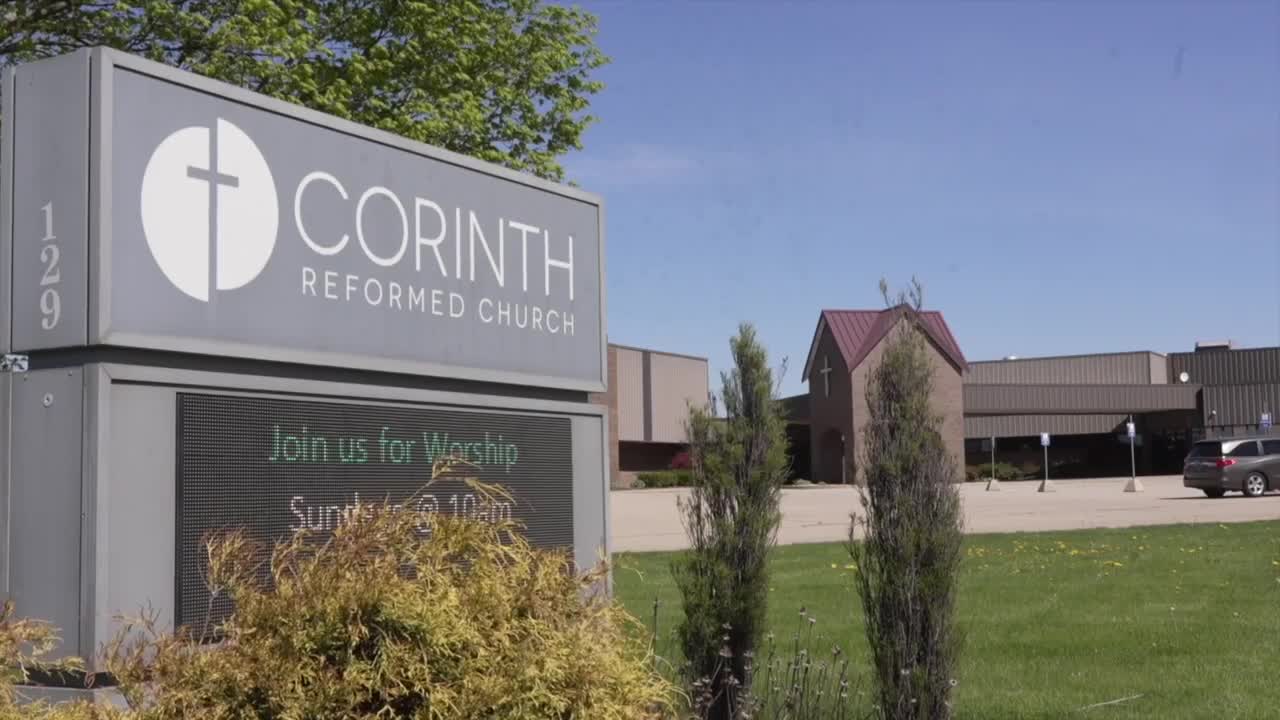


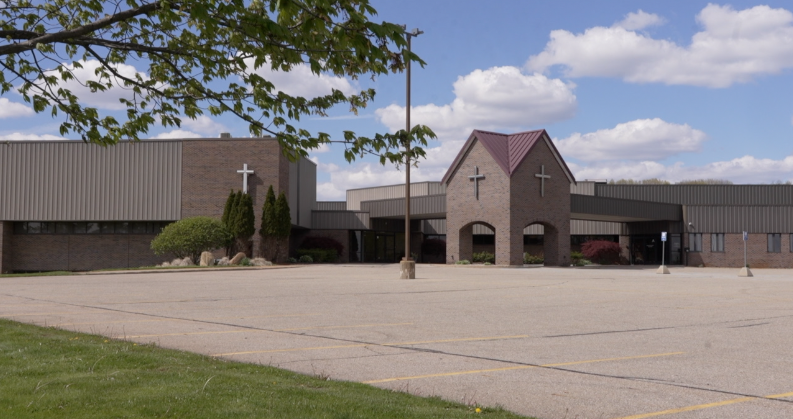
BYRON CENTER, Mich. — The Corinth Reformed Church sits at 100th and Division in my Byron Center neighborhood, and it has stood there for well over a century. But the church isn't just a place of worship — it's the last remnant of an entire village that once bustled with life and then quietly vanished.
As America marks its 250th birthday, the history of Corinth, Michigan offers a window into how West Michigan was settled, built up, and in some cases, left behind.
The story of Corinth begins with settlers pushing into West Michigan. Among the earliest was the Cody family, whose arrival set the foundation for what would become a small but growing community.
"There was the Cody family, and they created a couple mills," said Pastor Jason Nagel of Corinth Reformed Church. " It was actually, on our land, or just behind this current property in the hills. They created two mills. And so when the town actually started, it was called Cody Mills."
The settlement was eventually renamed Corinth in 1871, after a surveyor plotted the city.
As the population grew, so did the infrastructure. A school, furniture factory, doctor's office, general store, blacksmith and eventually a church were all established in the years to follow. By the late 1800s, Corinth had become a significant stop along the route between Grand Rapids and Kalamazoo.
WATCH: The lost city of Corinth: How a Michigan village disappeared but left its church behind
"For quite a few years, they had the taverns, the horses. It was a major thoroughfare, from like Grand Rapids to Kalamazoo — it was a big deal," Pastor Nagel said.
By the 1890s, Corinth appeared poised for even greater growth. Talks of a railroad line coming through the village generated excitement. But a deal couldn't be struck, and the railroad went through Moline instead.

"It kind of became the end of the Corinth kind of village at that time, because, you know, the railroad is big deal, and so people ended up moving into Moline," Pastor Nagel said.
The village dwindled. But the church — established in 1893 and named after the city of Corinth — carried on.
Much of this history was preserved in a history book, created by a church member called A Century of God's Blessing, discovered by Gibson Nieuwenhuis, the church's family ministry director.

That history is still visible inside the building today. All 3 original cornerstones remain on display, offering a tangible connection to the church's founding.
"I think it's really amazing. A lot of our church members come through these doors in the morning on Sunday, and they see this legacy, this sort of time capsule," Nieuwenhuis said. "Like you can come and touch a brick that was laid in 1893."

For those leading the church today, its survival carries a deeper meaning.
"I think it speaks to God's faithfulness, right?" Pastor Nagel said. "He hasn't taken his hand. He wants to do something on these four corners for this area, to bring his kingdom here, and we get to be a part of that."

The church has served the community for more than 130 years — long after the village it was named for disappeared.
This story was reported on-air by a journalist and has been converted to this platform with the assistance of AI. Our editorial team verifies all reporting on all platforms for fairness and accuracy.
