

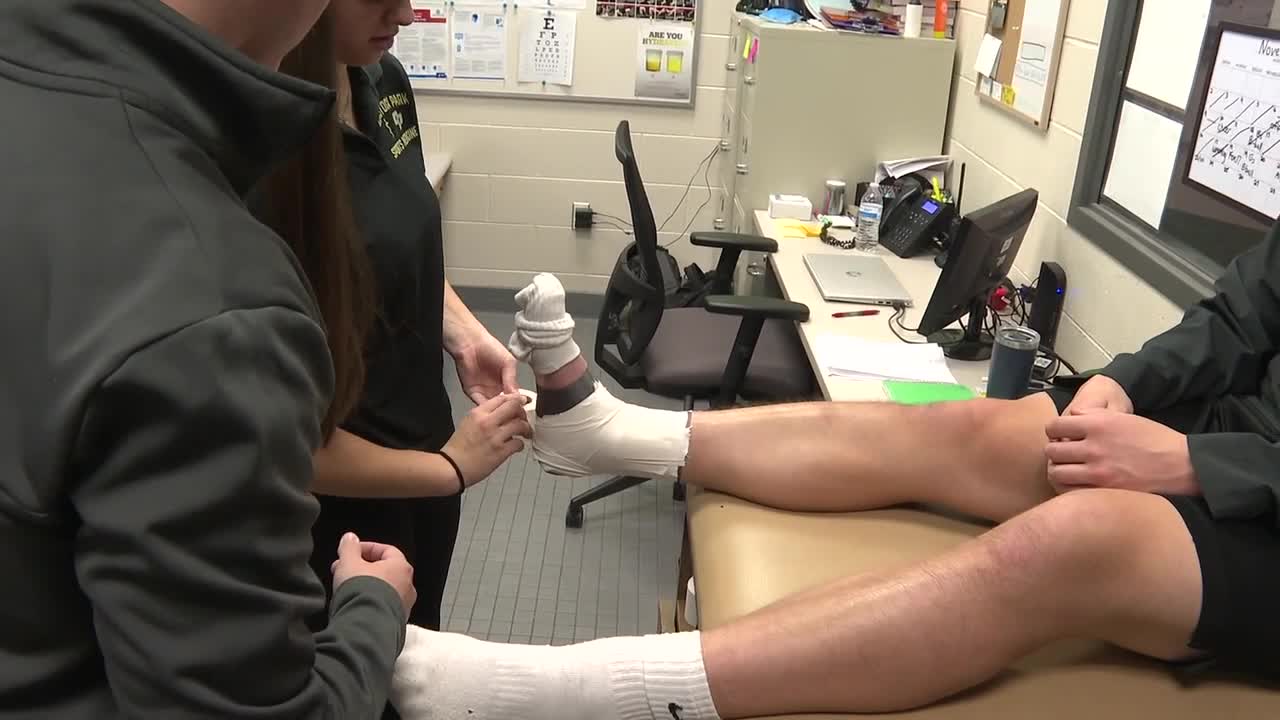


COMSTOCK PARK, Mich. — In a small room tucked away near the gymnasium at Comstock Park High School, while most students are heading home after the final bell, juniors Brielle Gates and Sofia Hargett are just getting started on what might be the most important education they'll receive this year.
They're not cramming for calculus or dissecting frogs in biology class. Instead, they're learning to tape ankles, assess injuries, and navigate the delicate balance between a teenager claiming their ankle is "broken" and determining if it really is just a minor sprain.
"I think what I've learned is some patients are always being super truthful, so you kind of have to figure that out for yourself," Gates explains with the wisdom of someone who's already mastered the art of reading people. "Is this a real injury, or is this kind of not a real injury?"
Welcome to the school's inaugural student athletic trainer intern program, where Comstock Park High School athletic trainer Sam Corbin has taken on two "guinea pigs" – his words, not mine – to help launch what he hopes will become a growing pipeline for future healthcare professionals.
Corbin, who earned his master's degree at Grand Valley State University (now a requirement for athletic trainers, up from the previous four-year bachelor's program), saw an opportunity when these two students expressed interest in healthcare careers.
"What really stuck out is them wanting to be in the health care and health field," Corbin says. "I wanted to have those students who had the interest, so that I can teach them a little bit what goes on in athletic training, but just overall, what it's like being a healthcare professional."
For Gates, who dreams of attending the University of Michigan to study biology before becoming a physician's assistant, the program offers a window into a field she's been curious about since her brother's medical problems sparked her interest in healthcare.
Hargett, meanwhile, is exploring pediatric medicine, and both students are discovering that athletic training is far more complex than most people realize.
"I think a lot of people think about training as just like taping and ice, but there's so many more aspects," Gates reflects. "You really do connect with the students on a different level than like I talk to people here that I wouldn't usually talk to during school."
During football season, both students – who play volleyball themselves – would finish their own practice and then hurry over to help Corbin until 6:30 p.m. when football wrapped up. They attended both home and away games, watching him evaluate injuries on the field and learning to assist with everything from minor cuts to concussions.
"One patient of ours had a really serious concussion, so that was scary, and then also a lot of ankle issues that we look at," Gates recalls, describing some of the more challenging cases they've encountered.
The hands-on learning includes mastering the art of taping – "remembering like, what strips go on, what for the ankle, and there's just kind of an order that you have to follow," Gates explains – as well as understanding more advanced treatments like electrical stimulation and rehabilitation protocols.
But perhaps the most valuable lesson has been learning to connect with their fellow students in a completely different context.
"You get to learn more about everyone," Hargett adds, describing how the athletic training room becomes a place where typical high school social boundaries fade away in favor of genuine care and concern.
For Corbin, watching his students grow has been just as educational as teaching them. "They have grown a lot," he observes. "When they kind of just saw how they were as an athlete on the court, they kind of did not know what it was like on the injury side of things, whether it's physically or mentally."
The program is already showing signs of success, and Corbin has plans for expansion. "The program is growing. Hopefully next year, we'll have some more high school athletes, and then possibly have some college students as well coming in here."
It's the kind of practical, hands-on learning that you can't get from a textbook, and both students are making the most of it. They're discovering that being a healthcare professional involves equal parts technical skill and emotional intelligence, scientific knowledge and human compassion.
"You really get to meet every single person here, and you become get a closer relationship," Hargett explains, capturing something essential about what healthcare is really about – the connection between caregiver and patient.
Do you have a story idea in Walker, Northview, or Comstock Park? Email robb.westaby@fox17online.com
This story was initially reported by a journalist and has been converted to this platform with the assistance of AI. Our editorial team verifies all reporting on all platforms for fairness and accuracy.