

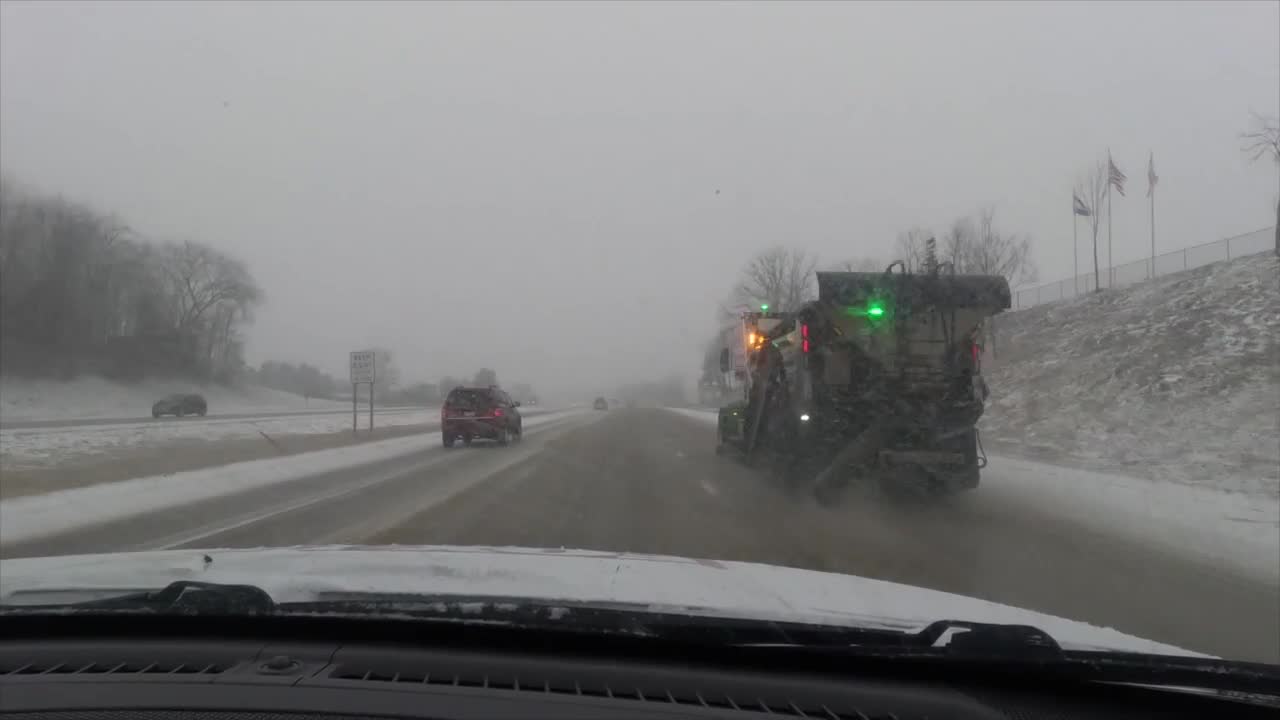


WALKER, Mich. — With temperatures hovering near zero and snow squalls reducing visibility to mere yards, even the professionals whose job it is to clear the roads are feeling the strain.
"One of the biggest challenges that maybe is forgotten is these cold temperatures are not only hard to drive on and clear roads on, but it's very hard on our equipment," explains Steve Roon, the road commission's director of maintenance and local road construction. The steel components, the bolts, the welds – everything contracts in the bitter cold, putting stress on machinery that's already working around the clock.
But it's not just the machines feeling the pressure. The human element carries its own challenges in this seemingly endless chain of snow events that have defined our January. Drivers work day shift or night shift, but those trucks never stop rolling – 24 hours a day, seven days a week. Each operator might have a route stretching 50 or 60 miles, driving it multiple times daily. Roon points to that as a hazard for road commission drivers.
"It's staying focused on your job and looking out for those hazards," Roon emphasizes. "That's why we're always asking motorists to see us with our lights, give us that extra room and stay 200 feet behind us."
Two hundred feet is a longer distance than most drivers realize – roughly the length of two-thirds of a football field. When plow trucks are moving at 35 miles per hour or slower, that distance disappears quickly for vehicles traveling even just 45 mph, Roon notes.
The commission's responsibilities extend beyond county roads. Through contracts with the Michigan Department of Transportation, those green trucks work the freeway system too, creating a prioritization challenge. High-speed, high-volume roads get attention first – the highways, the primary routes like 10 Mile Road and West River Drive. These roads receive care both day and night.
Secondary county roads, the neighborhood streets that connect our daily lives, get attention during daylight hours after the primary system is maintained. It's a hierarchy that makes practical sense but can leave some neighbors feeling forgotten.
The gap between driver expectations and winter reality creates its own set of challenges. On a day like Martin Luther King Day, with light traffic, some motorists use that extra room to increase speed, even when conditions don't warrant it. The result? Slide-offs and accidents — especially pile-ups like the one that closed I-196 in Hudsonville for seven hours — that strain emergency responders who are already stretched thin.
"Sometimes when traffic is light, people may tend to feel that room and use it to speed up," Roon observes. "And even though the conditions maybe aren't warranting that speed, they drive a little faster in that room."
Roon identifies the biggest mistake drivers make: assuming conditions remain constant. A motorist might experience clear visibility for miles, then suddenly encounter a snow squall where visibility drops to less than 100 yards. That mental preparation – knowing what to do when you can't see – can mean the difference between arriving safely and becoming another statistic.
Those 70 mph signs on the highways? They're not suggestions for current conditions. The right speed is whatever combination of vehicle capability, equipment quality, and skill level allows safe travel. Not everyone operates at the same level, and good drivers recognize that reality.
Do you have a story idea in Walker, Northview, or Comstock Park? Email robb.westaby@fox17online.com
This story was initially reported by a journalist and has been converted to this platform with the assistance of AI. Our editorial team verifies all reporting on all platforms for fairness and accuracy.
