




(WXYZ) — For a lot of allergy sufferers in Metro Detroit, spring starts with a simple routine: check the pollen count and brace for the day. But in Michigan, the number on your phone may not be based on real local measurement at all.
Watch Keenan Smith's report below

"Pollen data over the US is very sparse," said Allison Steiner, PhD, a Climate & Space Science and Engineering at the University of Michigan. "And in fact, we don't have any sampling stations that are run by the National Allergy Bureau here in Michigan."
The National Allergy Bureau has 85 monitoring stations across the country, which are considered the gold standard in real-time pollen tracking. But not one of the more than 7 dozen stations is here in Michigan, leaving millions of us without the kind of verified local allergy data available elsewhere.
"You have a spring pollen season. In the fall, we're really talking about weed allergies," Dr. Steiner said.
At the University of Michigan, Dr. Steiner studies how pollen moves through the air. She says actual monitoring matters because it gives researchers the ground truth they need to improve the forecast.
"The data is important because it provides a good ground truth for understanding when pollen counts are high," Dr. Steiner said.
And while Michigan has zero National Allergy Bureau monitoring sites, Wisconsin has four, and Ohio has two.

Dr. Garen Wolff, a Board Certified Allergist and Immunologist at the Detroit Medical Center, says it’s not that Michigan is a lower priority.
"It's more of a logistical aspect. You have to have a sponsoring allergist who is a member of the American Association for Allergy Asthma Immunology," Dr. Wolff said.
For this to be a priority, you have to have the right equipment, which can be expensive. You also have to hire and train someone to manually count pollen under a microscope, which can take an entire workday. And the local allergist is paying for it all.
"And with all those factors, it can be very difficult to find someone who can really put all of that together for a particular state," Dr. Wolff said.
So Michiganders are left with estimates based on other states or past patterns. In other words, what looks precise on a weather app may be anything but.
A January study in the Journal of Allergy and Clinical Immunology: Global put daily pollen forecasts from The Weather Channel and AccuWeather apps to the test.
The findings: forecast accuracy for the AccuWeather app was 7 percent for grass and 33 percent for ragweed. For The Weather Channel, the accuracy was at 29 percent for grass and 34 percent for ragweed. That’s worse than flipping a coin.
And for families deciding when to start medication, when to send kids outside, or when to stay in, that gap can matter.
On an Ann Arbor rooftop, Steiner’s team is using an automated sensor in her research.
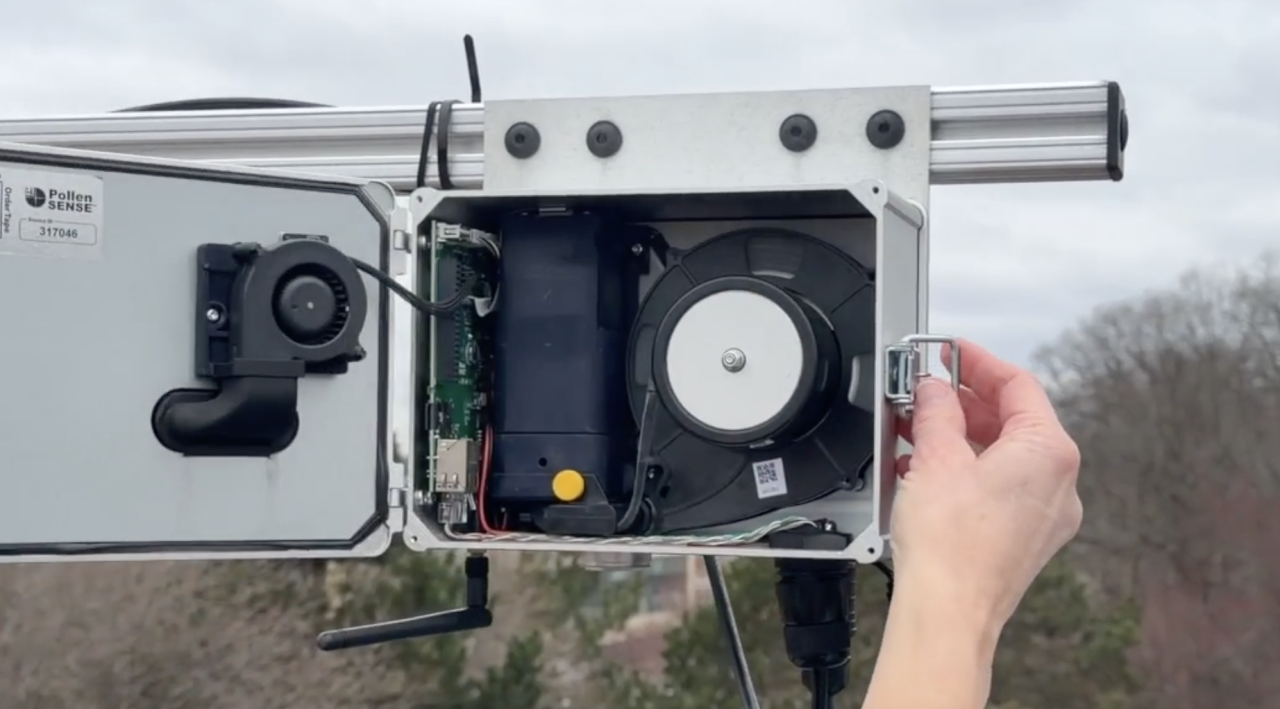
"This is the tape cartridge, which is collecting the samples along this tape right here," Dr. Steiner said.
This automated tool collects pollen and uses a camera and microscope to identify the allergens. It has less of the manual work of traditional stations when the artificial intelligence kicks in.
"These big, large, sort of glowy ones are pollen. This is actually a pine pollen," Dr. Steiner said.
Dr. Steiner is working with scientists at the National Oceanic and Atmospheric Administration to improve air quality forecasts. But there are still several years before that is on your phone.
On top of that, the allergy season is getting longer, and that means more exposure, more symptoms, and more days when people are left looking for answers in pollen counts that may not fully reflect what is in the air they breathe.
These new pollen sensors are part of a solution, and Dr. Steiner's work with NOAA is another part. But if you're suffering from allergies this season, sadly, there is no quick fix.
