

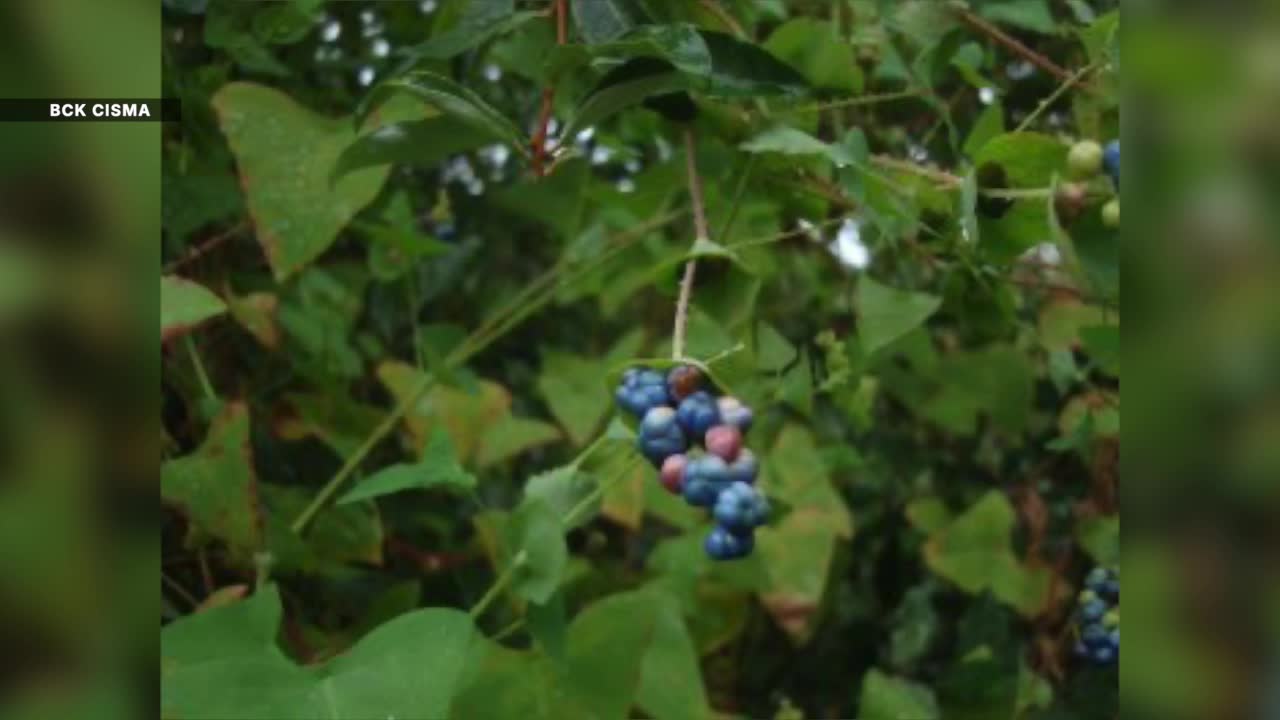


CALHOUN COUNTY, Mich. — An invasive vine that has been the focus of years of control efforts in Calhoun County has now been confirmed in neighboring Jackson County, marking the first confirmed Michigan infestation outside of Calhoun County.
According to the Michigan Department of Natural Resources, the newly confirmed infestation was found less than two miles from the nearest known infestation in Calhoun County, where mile-a-minute weed was first detected in Michigan in 2020. Survey crews have searched thousands of acres in both counties and have not identified any additional infestations beyond the newly confirmed Jackson County site.
Since the first Michigan detection, crews have identified 119 infestation sites, treated about 480 infested acres and surveyed more than 34,000 acres as part of an ongoing effort to contain the invasive vine.
"This plant is a really big deal in Michigan because it's truly not found here very much right now," said Katie Grzesiak, the DNR's terrestrial invasive species coordinator. "We only have populations known in two counties. Jackson County is our newest county, but the majority of our populations are actually in Calhoun County."
Grzesiak said the limited number of infestations gives crews an opportunity to respond before the weed becomes established across more of the state.
"It's kind of like weeding your garden," she said. "If you weed your garden when there's just a couple of weeds, it doesn't take very long. It doesn't hurt your back so much, versus if you wait until there's weeds everywhere, it's going to be a big horrible project. This is the prime example of early detection and response because there's just not that much of it in the state yet, and so we want to act while we are ahead of the game."
Native to Asia, mile-a-minute weed is a fast-growing annual vine that can quickly overtake trees, shrubs and other vegetation, blocking sunlight and crowding out native plants. It can also invade forest edges, orchards, vineyards, hayfields and Christmas tree farms.
"It grows really, really quickly," Grzesiak said. "Because it's not native, it doesn't have any of the food web checks and balances. There's not a lot of stuff that eats it ... and because it's a vine, it's able to overtop areas."
The plant spreads by seed. According to the DNR, birds can carry seeds to new areas, while people can unknowingly spread them on muddy shoes, clothing, pets and outdoor equipment.
"The seeds can get caught in the dirt in our shoes," Grzesiak said. "It is really important to pull any plant fragments off of our vehicles and ourselves and our pets before going to the next site because that can be a big way to stop the spread of this species and many other invasive species."
Grzesiak encouraged residents to report suspected sightings through the Midwest Invasive Species Information Network, or MISIN, by submitting a photo through its website or free mobile app.
"After you've been outside, whether that was going for a hike or working in your garden or on your farm, make sure you're cleaning yourself, any pets, and also any equipment and supplies before you move to a new site. It makes a huge difference for all invasive species," Grzesiak said.
This story was reported on-air by a journalist and has been converted to this platform with the assistance of AI. Our editorial team verifies all reporting on all platforms for fairness and accuracy.
