

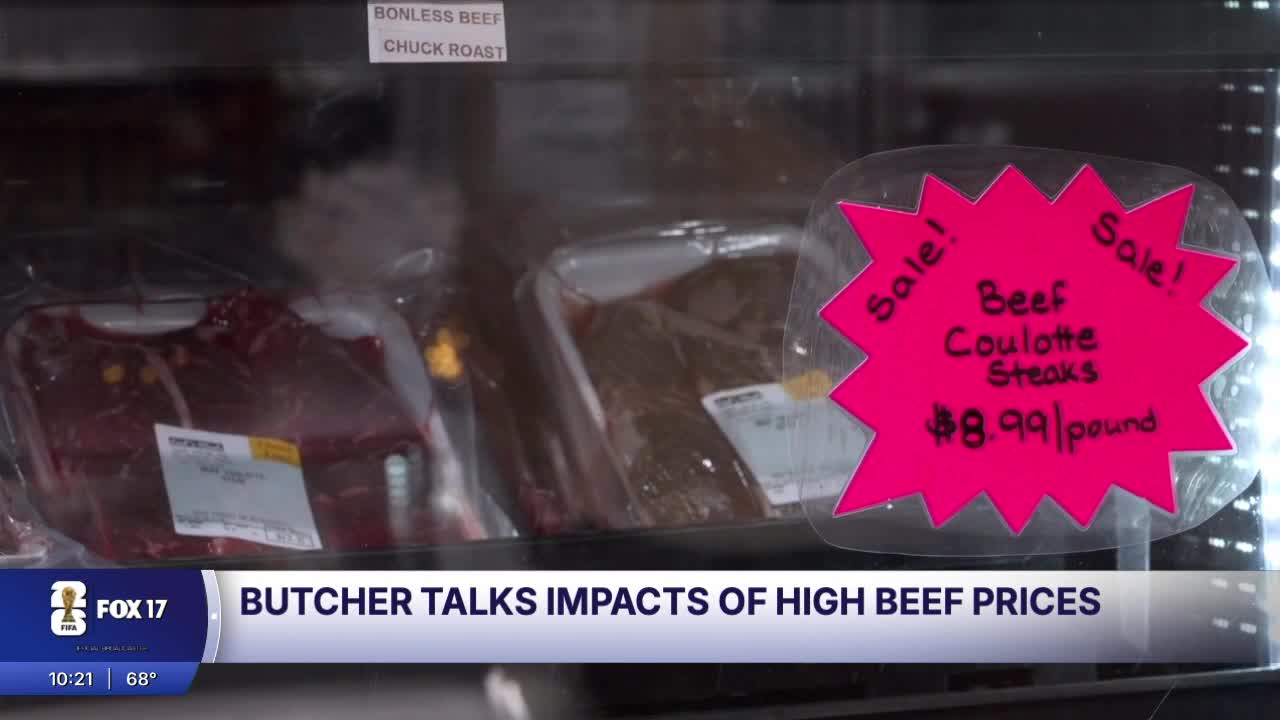


HOLLAND, Mich. — Rising beef prices are hitting both butchers and buyers, but demand for the product shows no signs of slowing down.
Laura Draisma of Earl's Meats in Holland said strategic sourcing has helped her father's butcher shop manage costs, but only to a certain point.
WATCH: Rising beef prices hit butchers and buyers, but demand remains strong in Holland
"We work hard to source from several different sources and kind of price compare, so that we can keep steady prices, and just the increase is inevitable. It's going to happen," Draisma said.
Draisma said a shrinking national beef herd and elevated fuel prices are among the key drivers behind the rising costs.
Despite those pressures, she said demand at the shop has not let up.
"It's interesting that demand for beef stays steady or increases when the price continues to increase, whereas we see chicken and pork staying very steady," Draisma said.

Pierce Bennett, the Livestock Industry Relations Specialist with the Michigan Farm Bureau, said that sustained demand reflects how American consumers view beef.
"The American consumer has, by and large, said we believe beef is a healthy, nutritious, a delicious product that we want to feed ourselves and our families, and so, yes, beef prices are elevated," Bennett said. "But we've also seen the American consumer say we value beef enough to continue purchasing even at these prices."
Bennett said the national cattle herd is at its smallest in decades.
"We're at the lowest cow herd numbers nationally since I believe 1961 so pushing 60 plus years now, 65 and there's a few factors for that," Bennett said.

One major factor is drought in the Western United States, particularly in the Rocky Mountain region, where a lack of grass makes it difficult to rebuild herds. Bennett also pointed to shrinking agricultural land access.
"You also have just a lack of land access, right, [that] we continue to see as competition continues across the country for higher land values and volumes of land, as less land is utilized in an agricultural way," Bennett said.
Bennett said the recent return of the New World screwworm fly to the United States has compounded the problem, particularly at the U.S.-Mexico border.
"Due to Mexico having issues with the New World screw worm pest, we have had our border closed at the Rio Grande River for almost two years now, and what many don't know is that historically there's been a fantastic live cattle trade across that border, with many of those calves coming from Mexico to the US to be fed out, and then, of course, marketed here within our system," Bennett said.

He said those converging factors — shrinking herds, drought, land competition and border restrictions — are driving prices higher through basic supply and demand.
Back at Earl's Meats, Draisma said the shop is finding ways to help customers manage the higher costs.
"We try to keep our price lower than the big box prices if we can, just to get people a deal, and we've developed a newer product to us, half beef, half pork ground product that can be substituted for anything you would use ground beef for," Draisma said.
This story was reported on-air by a journalist and has been converted to this platform with the assistance of AI. Our editorial team verifies all reporting on all platforms for fairness and accuracy.
