

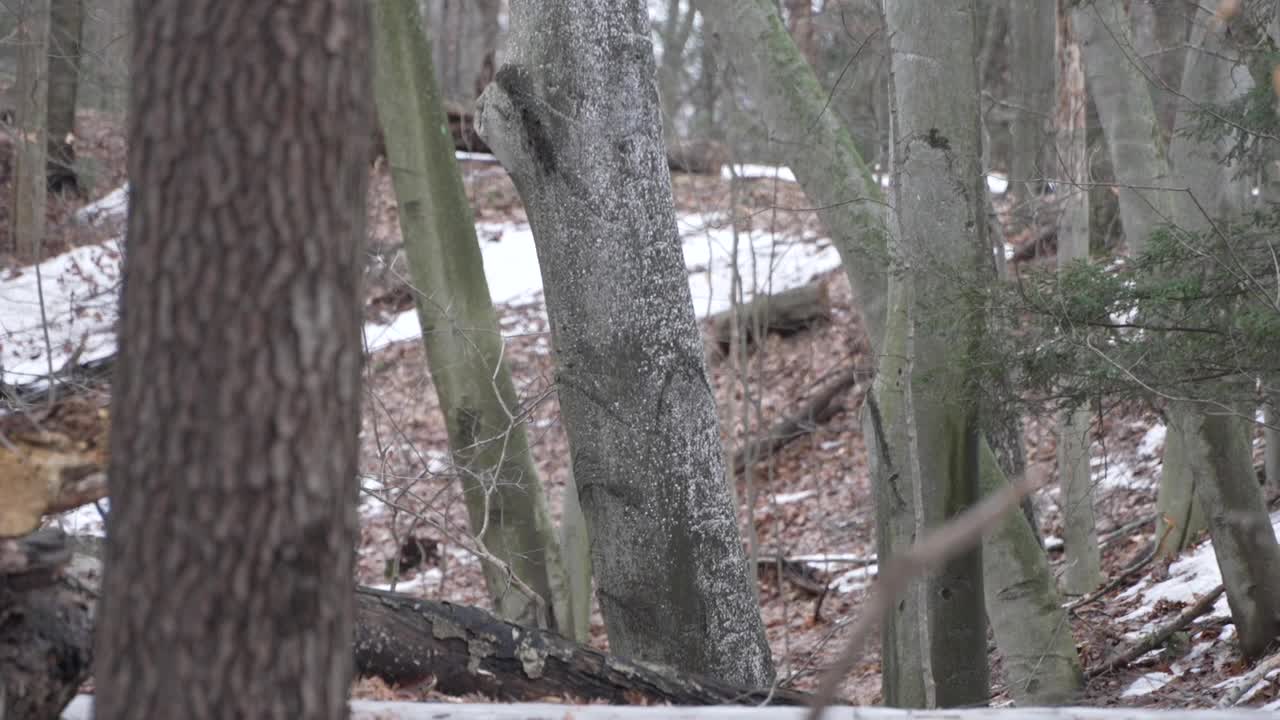


GRAND HAVEN, Mich. — A Grand Haven resident is advocating for more aggressive forest management techniques, including prescribed burns, to save the city's forests from disease and invasive species that he says are killing the trees.
WATCH: Can prescribed burns help save Grand Haven's forests or is it too dangerous?
Zebulon Boeskool, who has walked Grand Haven's forests since childhood, believes the city's recently adopted forest management plan doesn't go far enough to address the root causes of forest decline.
"I spend time out here with my kids. It's just a magnificent place to grow and learn," Boeskool said.
The plan was adopted in December and runs through 2030 with the city spending $175,000 in 2025-26. The goal of the plan is to protect and restore Grand Haven's forest. However, Boeskool argues the approach is too narrow.
"It really is open ended, it's just keep treating diseased trees. Well you're going to keep having diseased trees if you don't take care of the soil and if we don't take care of the soil we're just going to keep spending money," Boeskool said.
The debate highlights the ongoing challenge of balancing effective forest management with public safety in urban-adjacent natural areas.
Boeskool advocates for soil testing and a more holistic approach that includes prescribed burns, which he says would provide trees and native plants with the potassium they need to survive.
"Doing something like a prescribed burn might be hard but there are other options," Boeskool explained. "We could burn the wood that's existing through community efforts. Bring it to the top of the dunes blow it back down and let gravity do its thing. It might not be as good of coverage as a prescribed burn but it's better than nothing."
Ali Locher, a professor of natural resource management at Grand Valley State University, acknowledges that prescribed burns can be deeply beneficial but warns they pose significant risks in areas like Grand Haven.
"In a situation like Grand Haven that is like the epitome of the Wildland Urban Interface. You know there's residential areas there's development all around it's risky. I'm not saying it couldn't be done but there's a super high risk and any introduction of fire has to be done very very carefully," Locher admitted.
Despite the challenges, Boeskool believes prescribed burns can be implemented safely and hopes the city will consider more comprehensive approaches to forest management.
"By taking a holistic approach to forestry we really run into a situation where maybe we can stop spending so much money, you know," Boeskool said.
The city's forest management division was unable to comment.
This story was reported on-air by a journalist and has been converted to this platform with the assistance of AI. Our editorial team verifies all reporting on all platforms for fairness and accuracy.
