



ADA TOWNSHIP, Mich. —
Residents Unite Over Safety Concerns
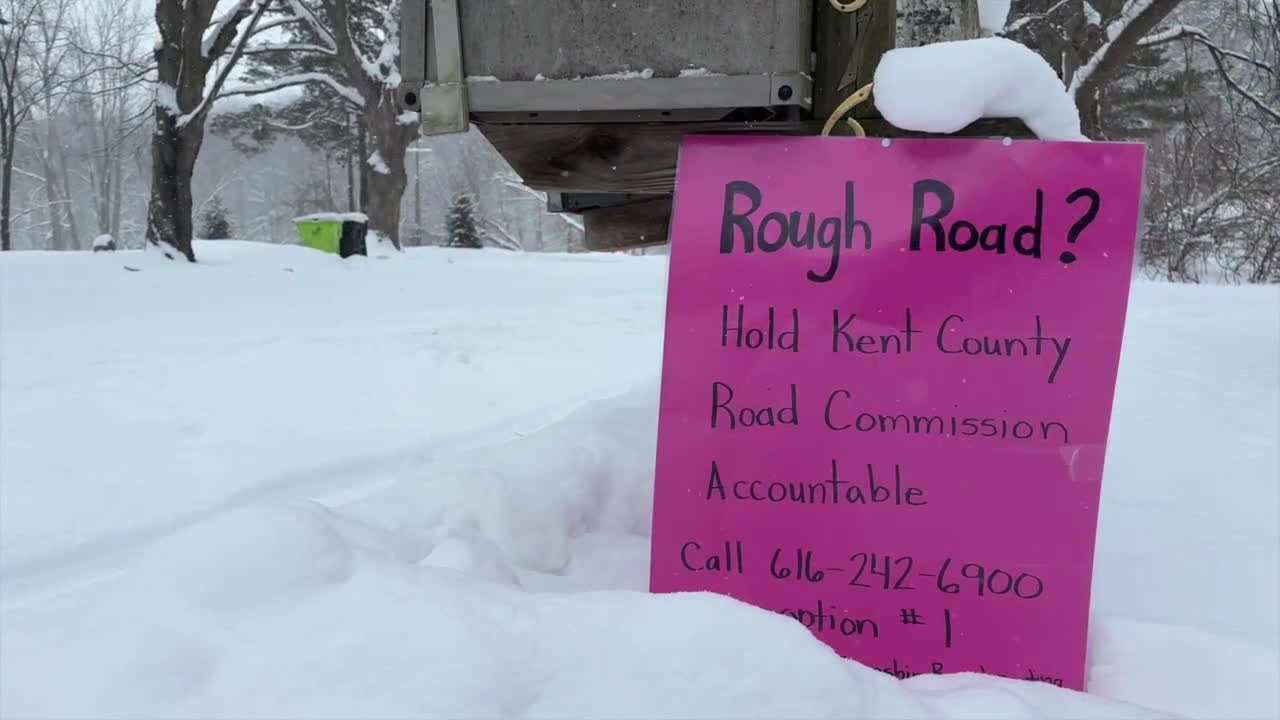
Residents on 3 Mile Road in Ada Township say they're frustrated with dangerous road conditions that include potholes and washouts, and they plan to attend Monday's township meeting to voice their concerns after years of saying nothing has been done to adequately address the repairs.
Jennifer Marsh, who has lived on the road for 21 years, says the conditions pose serious safety risks that have worsened dramatically in recent years.
"We get a lot of kids coming up and down this road, and I think it's a crime. It's a crime that they let it get this bad," Marsh said.
From Beauty to Burden: A Road in Decline
The road has natural beauty designation, which neighbors supported with a petition in 2007 to prevent paving.
"It was truly a natural beauty road. But the last five years, the road's gone to s***," Marsh said. "There's potholes everywhere, water running through potholes that you can step in deep enough to hit your knee at times, big troughs that keep us like dodging back and forth across the road and making it unsafe conditions."
Marsh said the dangerous conditions have caused injuries, including when her husband broke his foot after falling into a pothole while riding his bike a couple of summers ago.
"My husband was riding his bike a couple summers ago, broke his foot falling into one of the potholes. I mean, it's a serious, serious concern," Marsh said. "The kids can't ride their bikes down the road anymore."
Service Disruptions Mount
Neighbor Nevin Zolenski says school buses no longer come down the street due to safety concerns, forcing parents to meet buses at street corners.
"They used to come to our homes. Now they refuse because it was too dangerous, and buses are getting stuck. There's been a Kent County plow that got stuck at the bottom of that hill," Zolenski said.
Zolenski described the road as extremely narrow, saying "you're playing roulette with your lives, if you ever tried to go up and down it."
The road has also seen increased traffic over the years due to development in the surrounding area, with GPS systems directing drivers through the residential street according to neighbors. They add that delivery trucks and garbage trucks sometimes get stuck trying to navigate the steep hill, forcing them to reverse down the road.
County Response: Maintenance Challenges
"Kent County Road Commission had done nothing with the road," Marsh said, adding that when she called to complain, "they would say, conditions are too wet, conditions are too dry. Well, you live on a dirt road, and they were full of excuses."
Jerry Byrne, managing director for the Kent County Road Commission, acknowledged the challenges but said potholes are common on gravel roads, especially in winter conditions.
"Potholes form on gravel roads. They're going to repeatedly form in gravel roads, part of it in the wintertime. Underneath that gravel it's still froze so it's not letting the water drain away," Byrne said.
Byrne said crews graded the road within the past two to three weeks but were limited to spot grading due to weather conditions. However, neighbors say they didn't notice significant improvement.
"You can expect them to be here until the weather dries up and we can actually grade the entire road with a big grader, loosen things up, cut the potholes from the bottom," Byrne said.
Natural Beauty Designation Creates Limits
The natural beauty designation significantly limits repair options, according to Byrne.
"We can't just go in and cut trees and build, bring in ditches to make better drainage," Byrne said. "So it's going to be less quality maintenance on a natural beauty road because of those restrictions."
Byrne noted that increased traffic over the decades has worsened the road's condition. He said the road commission spends three times more maintaining gravel roads than it collects in revenue for them.
Despite neighbors' concerns about safety, Byrne said accident data shows the road is "reasonably safe," with only one accident in the past 10 years in the most problematic stretch and three accidents overall on the entire road.
"Safety wise, I think we're comfortable," Byrne said. "The other thing, you know, some people will say, keeping it narrow, keeping the trees forces people mentally to slow down."
Disputed Claims About Bus Service
Byrne disputed claims about school bus service, saying he spoke with Forest Hills Schools transportation officials who "have no record of saying, hey, it's too bad of shape. We're not driving on it."
However, neighbors maintain that buses no longer serve their homes directly, and mail delivery is sometimes skipped due to road conditions.
Path to Paving: Complex Process Ahead
Paving the road would require a multi-step process involving multiple public hearings and cost-sharing agreements.
According to Byrne, residents would first need to gather signatures from 25 freeholders within the township to petition the Road Commission Board to remove the natural beauty designation.
"By law, we have to have a public hearing," Byrne said. "If we get that petition and the signatures are verified, we hold a petition. We listen to the residents. We won't have 100% one either in favor or not, but we will listen to those if, if our board feels it's the right decision, based on safety, based on what the people want, we can take that designation off."
However, removing the designation doesn't automatically lead to paving.
"That doesn't get it built. It takes a designation off," Byrne explained. "We would take a second public hearing to construct it."
The second phase would require another petition specifically for pavement construction. The Road Commission would then design plans and hold another public hearing to discuss the project details and, crucially, who would pay for it.
"We design a set of plans. We meet with the residents, we talk about what it looked like. We have another public hearing. Do they want it paved? And then we also talk about who's going to pay for that and who pays for road improvements like that," Byrne said.
The cost-sharing formula is fixed: the Road Commission covers 45% of construction costs, while 55% must come from other sources.
"We at the road commission are going to cover 45% of the cost. 55% needs to come from some other source could be the townships. It could be people that just volunteer to pay with it, that live on the road. It could be a special assessment, a district where a district set up, and they pay by the by the frontage, so everybody pays their share," Byrne said.
There's also a catch about project scope: the Road Commission will only participate financially if the entire road segment is paved, not partial sections.
"When we cover the costs, it's for everybody that drives on the road, not just for a particular driveway," Byrne said.
Township Meeting Planned
The residents plan to present their case at the Ada Township Board meeting Monday at 7 p.m., hoping to get township support for a solution.
"We're a lot of really good people who live here and love this area, and we just want it to be pleasant for our families," Marsh said.
WATCH THE VIDEO STORY
This story was initially reported by a journalist and has been converted to this platform with the assistance of AI. Our editorial team verifies all reporting on all platforms for fairness and accuracy.

