

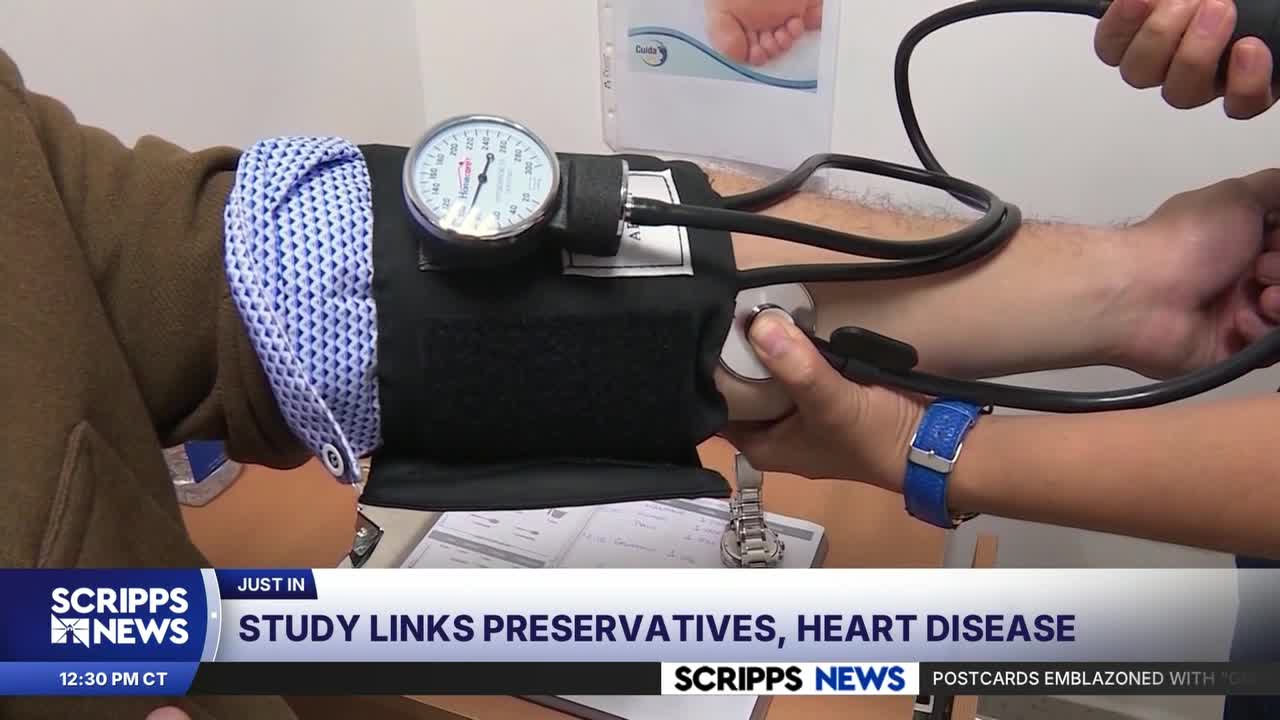


Common preservatives used in many store-bought foods to kill bacteria and mold were linked to a 29% greater risk of elevated blood pressure and a 16% higher risk of heart attacks and stroke, according to a new study from France.
Even so-called “natural” antioxidant preservatives used to stop discoloration, such as citric acid and ascorbic acid (widely known as vitamin C), led to a 22% greater risk of high blood pressure in people who ate more foods with those ingredients, the research found.
While antioxidants such as citric and ascorbic acid are found naturally in foods such as fruits, they are “not exactly natural” when used as preservatives, senior author Mathilde Touvier said in an email. Touvier is the principal investigator of the NutriNet-Santé study used to conduct the research.
RELATED STORY | Americans get more than half their diet from ultra-processed foods, CDC confirms
“Naturally occurring ascorbic acid and added ascorbic acid — which may be chemically manufactured — may have different impacts on health,” said Touvier, who is also director of research at France’s National Institute of Health and Medical Research in Paris.
“Thus, the results observed here for these food additives are not true for natural substances found in fruits and vegetables,” she added.
Not only ultraprocessed foods
The study sheds light on how different additives in ultraprocessed foods, or UPFs, could play a role in cardiovascular risk, and “echo the recent European Society of Cardiology consensus, which highlights UPFs as a global public health concern,” Tracy Parker, nutrition lead at the British Heart Foundation in London said in a statement. Parker was not involved in the study.
Ultraprocessed foods have been linked to an approximately 50% higher risk of cardiovascular disease-related death, and they may boost the risk of obesity by 55%, sleep disorders by 41% and the development of type 2 diabetes by 40%. Obesity, diabetes and poor sleep are closely connected to poor heart health.
“This is one of the first large studies to look at individual preservatives rather than treating ultra-processed foods as a single category,” Parker said. “UPFs have long raised concerns due to their high levels of sugar, salt and fat, but these factors alone have never fully explained why they appear more harmful than their nutrient profile suggests. These findings help fill part of that gap.”
However, prior research by Touvier and her team found ultraprocessed foods make up only 35% of foods with preservatives people consumed. That means “preservatives are ubiquitous,” said lead author Anaïs Hasenböhler, a doctoral student at the Nutritional Epidemiology Research Team at the Université Sorbonne Paris Nord.
IN CASE YOU MISSED IT | Walmart to remove dozens of synthetic dyes, ingredients from Great Value and other store brands
“There is no food group/item to remove from the diet in order to fix things,” Hasenböhler said in an email. “These results also support the recommendations for consumers to favour non-to-minimally-processed foods.”
Choose fresh, uncooked, unprocessed items, or if looking for the fastest to prepare and eat, choose “frozen options which are preserved through a low temperature, not necessarily through the addition of food additive preservatives,” she added.
More ‘natural’ preservatives associated with risk
The study, published Wednesday in the European Heart Journal, investigated the impact of 58 preservatives on the cardiovascular health of more than 112,000 people above the age of 15. All are participating in NutriNet-Santé, which has analyzed the diets of volunteers from across France since 2009.
To be in the study, each participant tracks every bite of their food and drink by brand name for three days every six months. Researchers then use a database of product ingredients to identify common preservatives and compare levels of consumption over years with medical data stored in the French national health care system.
Researchers did a deep dive on 17 preservatives consumed by at least 10% of the participants and found eight were associated with higher blood pressure over the next decade. Three of those — potassium sorbate, potassium metabisulphite and sodium nitrite — are “non-antioxidant” preservatives, which means they kill bacteria, molds and yeast that spoil foods.
Potassium sorbate is often used in wine, baked goods, cheeses and sauces. Potassium metabisulphite, which releases sulfur dioxide when dissolved, is found in wine, juice, cider, beer and other fermented beverages. Sodium nitrite is a chemical salt commonly used in processed meats such as bacon, ham and deli meats.
Nitrates and sulfur-based compounds are found in foods like red and processed meats, already known to increase the risk of heart disease. Therefore, that finding is should not be surprising, some experts say.
In addition, preservatives are needed if consumers want to continue to purchase foods they can store and eat later, according to Gunter Kuhnle, a professor of food and nutritional science at the University of Reading in England. He was not involved in any of the studies.
“Preservatives have an important role in the food system, not only by preventing food-borne diseases, but also by preventing spoilage, reducing food waste and extending shelf life,” Kuhnle said in a statement.
RELATED STORY | New study reveals 99% of heart attacks and strokes have warning signs that can be detected early
The remaining preservatives linked to high blood pressure in the study — ascorbic acid, sodium ascorbate, sodium erythorbate, citric acid and extracts of rosemary — are so-called natural “antioxidant” preservatives, used to reduce oxidation that turns foods brown and rancid.
Ascorbic acid, or vitamin C, was also specifically linked to cardiovascular disease, the study found.
Similar preservatives also linked to cancer, type 2 diabetes
The results support the findings of two other studies by Touvier and her team which found similar links between preservatives and a much higher risk of cancer and type 2 diabetes.
Six preservatives — sodium nitrite, potassium nitrate, sorbates, potassium metabisulfite, acetates and acetic acid — were linked to up to a 32% higher risk of prostate cancer, breast cancer and cancer of all kinds. All but one of those same preservatives also boosted the risk of developing type 2 diabetes by 49%.
While the findings of the new research are observational and cannot prove cause and effect, the study did a good job of controlling for other factors that may influence health, such as age, body mass index or BMI, smoking, physical activity and diet in general, said Rachel Richardson, a methods support unit manager for The Cochrane Collaboration, an international nonprofit highly respected for its scientific approach to research. She was not involved in the study.
“Other strengths of this study include the way in which they assessed people’s diets and their comprehensive approach to identifying hypertension and cardiovascular disease,” said Richardson in a statement. “Although they cannot prove causation, there are signals in the results that warrant further investigation.”
The-CNN-Wire™ & © 2026 Cable News Network, Inc., a Warner Bros. Discovery Company. All rights reserved.
