

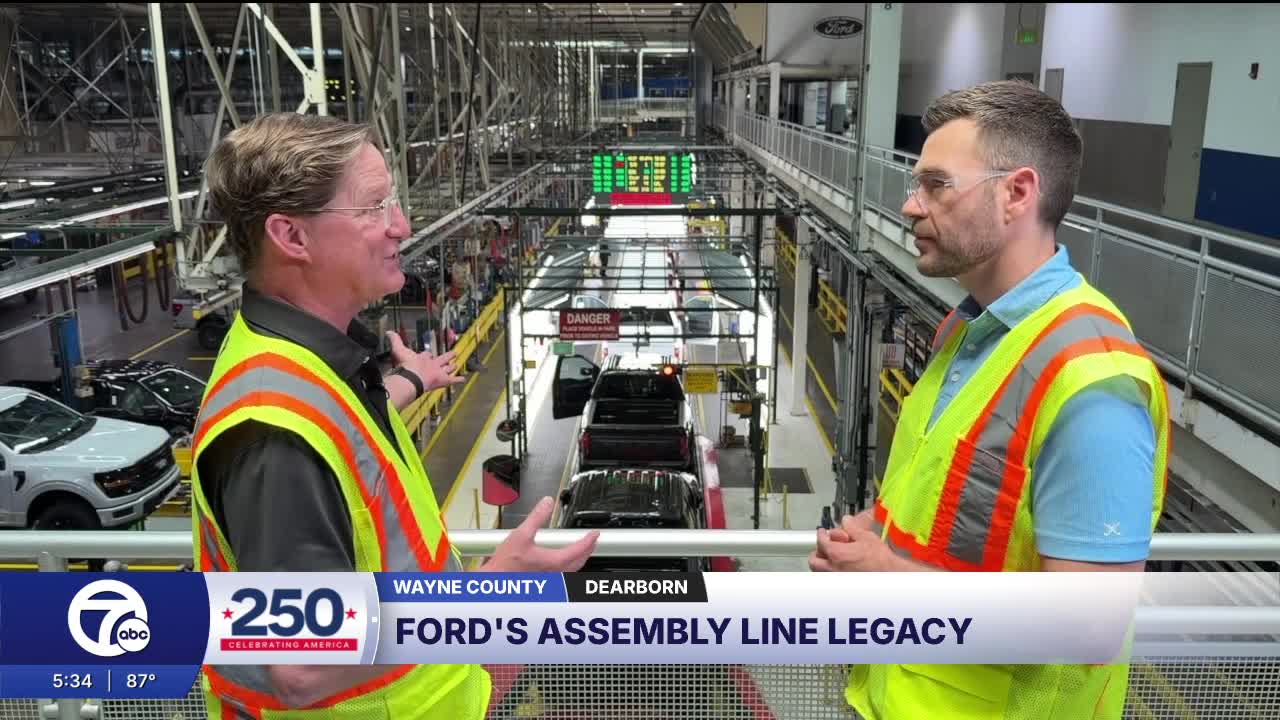



(WXYZ) — As we celebrate America 250, we look at Henry Ford’s assembly line. Its introduction had far-reaching effects on both industry and transportation, and the technology is still thriving today.
Watch Mike Duffy's video report:
The first Model Ts were hand-built at the Detroit Piquette Avenue Plant, but the modern assembly line was invented and perfected at the Ford Highland Park Plant. Then as demand for the automobile expanded, it was time for a bigger facility.
“We’re standing today at the Dearborn Truck Plant at the famous Rouge Complex that Ford began building in 1917. We’re watching F150s come off the line,” said Ted Ryan, archives and brand manager for Ford.

Today, a brand new Ford F-150 is minted every 53 seconds. It’s an engineering marvel, and it didn’t happen overnight.
“In 1908, the Model T was developed. And it’s the car that put the world on wheels. Affordable car, designed from the beginning to be a mass-produced car. And it was done at Piquette, but they were all hand-built at Piquette. The idea with Ford management, they had seen slaughterhouses, how a cow would go down the line and be slaughtered. And within the munitions industry, rifles were often produced by going down a line. And so P.E. Martin and Henry Ford got the idea that they could do it with a car,” said Ryan.
That's what sparked the idea for a modern assembly line.
“The modern assembly line is one of continuous movement, where it starts at one end and it finishes at the other end as a completely finished product," said Ryan. “What’s even more amazing is continuous movement over three different floors at Highland Park, so that the chassis might start on the third floor and it finishes on the second floor as a completely different floor, having gone down to the first and come back up again. The amount of planning and ingenuity it took to offer continuous motion where the parts could be applied to the car was just staggering.”
The technology spread like wildfire.

“It shaped culture, and it shaped the world because of an interesting fact… Ford gave it away. We invited our competitors and other industries to come and study our assembly line process," he said.
"Did it really spur the age of mass-industrialization?" I asked.
“The assembly line 100% spurred mass industrialization because you began to see it applied to other industries. You always had your special, you’re going to have Tiffany’s making Tiffany jewelry. But if GE can then figure out how to make a light bulb using autonomous processes, all these other things can be done in an assembly line process-driven formula, then the world becomes a more efficient place,” said Ryan.
The efficiency created new economies and spurred prosperity for many American families, like those of Felicia Ford and Jack Spitza.
“Ford had built the assembly line, but he needed skilled trades and assembly workers to do it, and my family was part of that," said Felicia Ford, a high voltage applications engineer. “My grandfather, he came up from Mississippi back in the 1920s and he started as a janitor and made it to a millwright.”

She added, “With that employment at Ford Motor Company and the $5 wage, he was able to raise a family of 14 children and be a middle-class family. That was unheard of back in the 20s and 30s for African-Americans.”

And she's carrying on that family tradition.
“I’m trying to continue that," she said. “I started in power-train, V6 and V8 engines. Gauging and tooling was my background. Cylinder blocks ... and now I’m on electrified vehicles, which is electrified power-trains, so it’s a full circle.”
Jack Spitza, assistant plant manager at the Dearborn Truck Plant, said he grew up in the heart of the auto industry.

“I grew up middle-class right here in Detroit," said Spitza. “Grew up hearing the stories around the dinner table of what it was to be a manufacturer, what it meant to the economy in Michigan, you know, and in the United States. So it was what I pursued as a career because of that.”
"What is that kind of invention, that kind of engineering, that kind of ingenuity mean when it comes to the American story?" I asked.
“It’s really about great efficiency, waste elimination ... and we just get better at what we do every day," said Spitza.
I also asked about what’s next, and they told me the world is changing and they’re working on changing with it. They’re working on hybrid technology and energy storage technology, and guess what, the assembly line isn’t going anywhere.
