

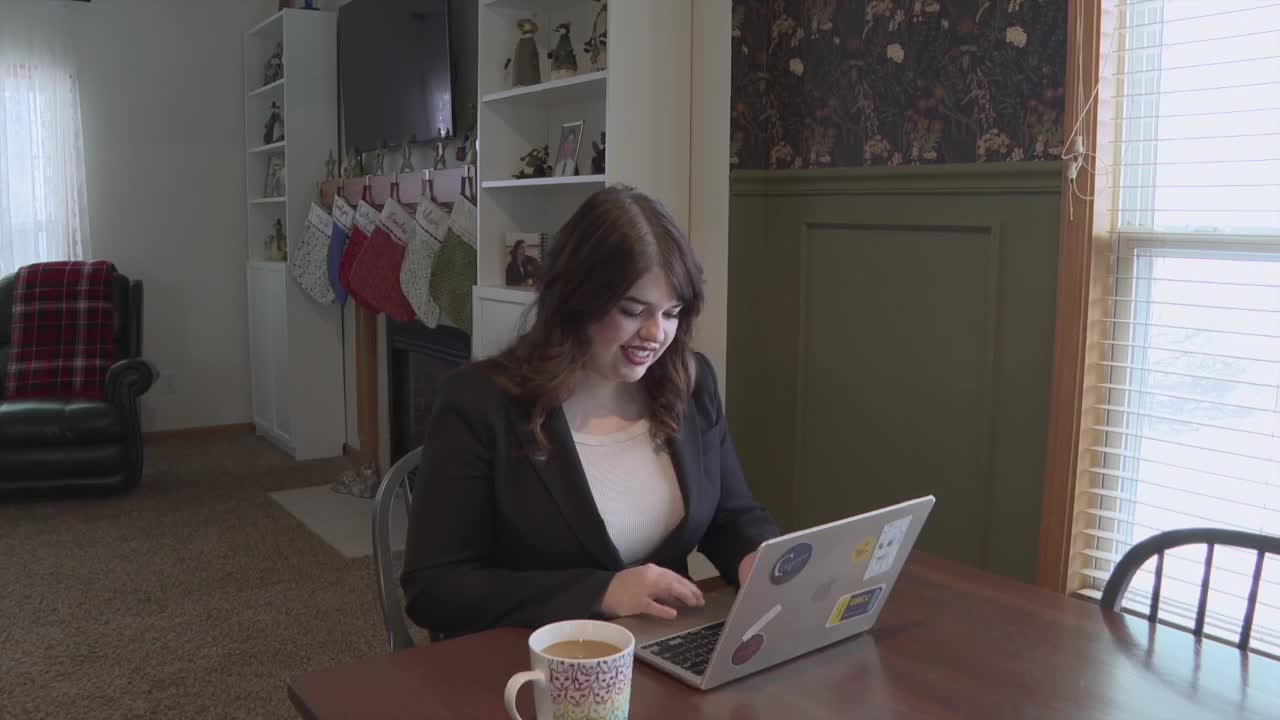


HUDSONVILLE, Mich. — A Hudsonville student who once struggled with chronic pain that kept her from fully participating in childhood activities is now the face of a national Michigan State University campaign, showcasing how local research helped transform her life.
For much of her childhood, chronic stomach pain prevented Karalynn Davis from being a typical kid. The condition significantly impacted her daily life and education.
"I missed a lot of school. I missed a lot of social events, especially in middle school, just because I was scared that I would have to leave or I would get sick immediately after," Davis said.
For her mother, Sondra, the most challenging aspect wasn't just watching her daughter suffer — it was the absence of clear answers about her condition.
"With IBS, there's nothing that you can really see. You never knew when it was going to flare up. You don't know what's going to trigger it. So it's just, it's hard to sort of live with," Sondra Davis said.
Everything changed when Karalynn joined a Michigan State University research study focused on chronic pain in children. The study provided both validation and practical solutions.
"They did MRI brain scans so that we could actually see that the pain really did exist. So that was really nice to have something, especially for her, you know, to actually back up what she was feeling," Sondra Davis said.
The research didn't just validate Karalynn's pain — it equipped her with tools to manage both the physical symptoms and the anxiety that accompanied them.
"I feel like I gained a really, like, holistic understanding of my entire body through this awesome research study," Karalynn Davis said.
The study was led by Michigan State University Professor Dr. Natoshia Cunningham, who emphasizes that chronic pain in children is far more prevalent than many people understand.
"Upwards of 20 to 25% of kids experience chronic painful conditions. What we were able to show with our neuroimaging research is that the brains of kids who experience chronic pain — they function differently than kids who don't have chronic pain," Cunningham said.
Cunningham says this research extends beyond a single study. The work is now expanding into schools and primary care settings to help identify and support children earlier in their journey.
"If we can reach them early and get them access to accessible and effective interventions, we can help build resilience in kids who experience chronic pain," Cunningham said.
What began as a research study has now placed Karalynn in the national spotlight, making her the face of a Michigan State University campaign that highlights how research is changing lives.
"People come up to me at my school and at my work and they say, I saw you. I didn't tell anybody that I was doing this. I wanted them to be surprised," Davis said.
At 19, Karalynn is preparing to transfer to Central Michigan University and pursuing her dream of becoming a broadcast journalist.
"It really means everything. I feel very empowered from this study. I just feel like I can take on pretty much anything that life throws my way," Davis said.
This story was reported on-air by a journalist and has been converted to this platform with the assistance of AI. Our editorial team verifies all reporting on all platforms for fairness and accuracy.

