

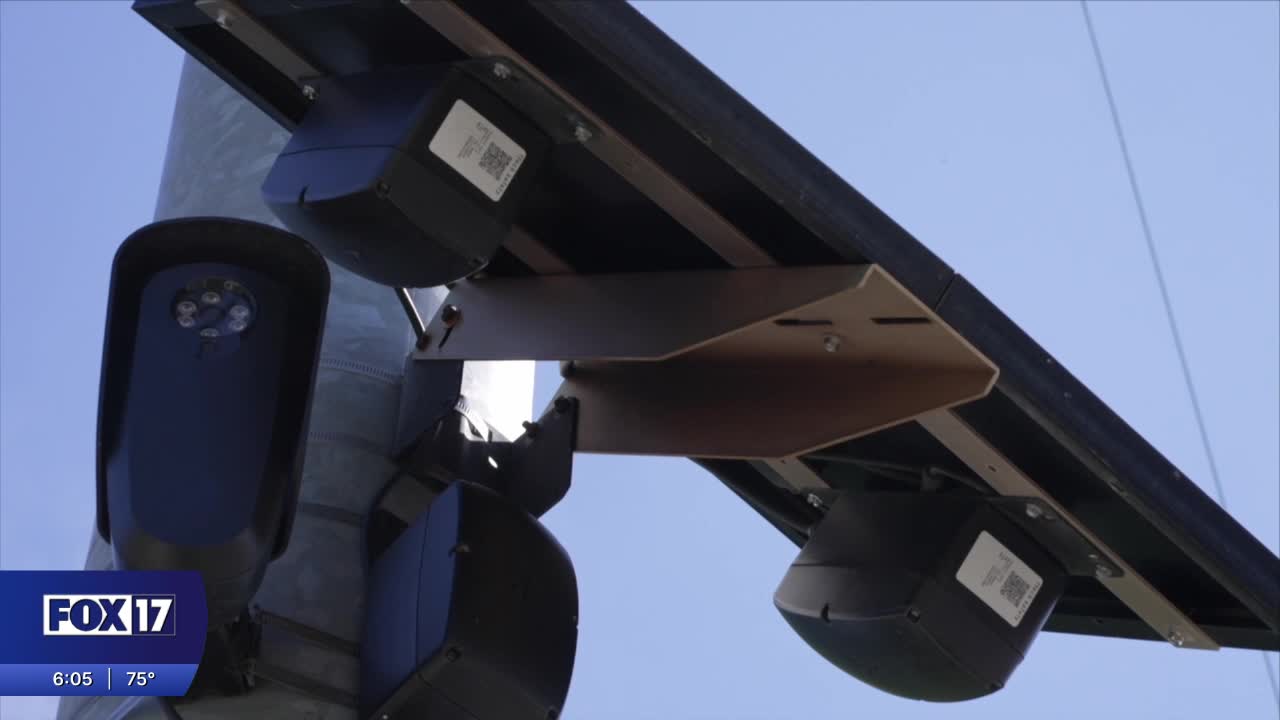



GRAND RAPIDS, Mich. — Community concerns over how the Grand Rapids Police Department uses Flock Safety cameras prompted the department and the software technology company to give a presentation on Tuesday to the Grand Rapids Public Safety Committee.
"We have heard the concerns," GRPD Deputy Chief Mike Maycroft said. "I don't know if we're going to change everybody's mind on this technology, but I think it's important for us to understand how Grand Rapids uses it and the safeguards we have in place."
In January 2024, GRPD agreed to a 24-month contract with Flock Safety and has since installed 31 of its cameras in the city.
The department's cameras are pointed at roadways and capture still images of the license plates of passing cars whose drivers and passengers are "rarely visible," per Flock Safety.
During Tuesday's presentation, Maycroft said GRPD does not use the technology for facial recognition, live video recording, audio recording, surveillance of private property or searches related to immigration and reproductive health.
"Flock is a tool," Maycroft said. "It's not a substitute for constitutional policing."
When GRPD uses a Flock camera, the department says it is for casework related to homicide, criminal sexual conduct, human trafficking, kidnapping, AMBER or Silver Alerts, wanted persons or stolen vehicle recovery.

Grand Rapids
Grand Rapids police defend use of Flock cameras
Dozens of Grand Rapids neighbors attended the presentation.
"We don't want the cameras in our city," said Gema Lowe, a community organizer with Movimiento Cosecha Grand Rapids, a local group that advocates for immigrants.
"We are concerned that this tool is another tool to be separating our families," Lowe said.
Flock Safety directly addressed immigration-related concerns.
"Let's just hit this straight on. We are the only major [automatic license plate reader] provider in the network that does not have contracts with DHS and ICE," spokesperson Kerry McCormack said during the presentation. "Within our system, they do not have an account. You cannot directly share with them in our system."
"We get this question, and out of the competitors that are out there, we're the only one that doesn't have multimillion-dollar contracts with them," he said.
Flock also said a law enforcement officer must input a "valid criminal offense" in order to search their department's Flock system for a license plate.
In 2027, it said it "all agencies" would need to input active case numbers in order to complete a search.
"Right now, we're assured that Flock does not have a contract with or work with those individuals, and that data cannot be sold nor shared," said Jim Davis, a citizen member of the Grand Rapids Public Safety Committee. "But I think the general public, in general, is wondering what and how that might change, and how can we be assured that it won't change?
Since it began contracting with Flock, Maycroft said a GRPD officer once "accidentally" classified a search in the department's Flock system as related to immigration enforcement.
Maycroft said an audit flagged the search and, after an investigation, GRPD determined it was "absolutely" unrelated to immigration and attributed to "human error."
Lowe called the search "concerning."
"They call it a mistake," she said. "Who knows if it was a mistake or not, it is concerning."
She'd rather see the city's "manpower and money" be put toward programs related to mental health and substance abuse.
"Flock cameras are just another system that's watching me," she said.
At the conclusion of Tuesday's presentation, the Grand Rapids Public Safety Committee said it wanted to receive an annual report from GRPD on its use of Flock cameras and automatic license plate readers.
"We want to know not only where is the data going, but what data is being shared? How many cameras do we have" Where are those cameras? How do we get more cameras? And as policy is changing, who's making sure that policy is being shared with the general public so we understand who's using it and for what purposes?" Davis said.
"I think we asked more questions than we got answers for today, but it's a step in the right direction," he said.

