

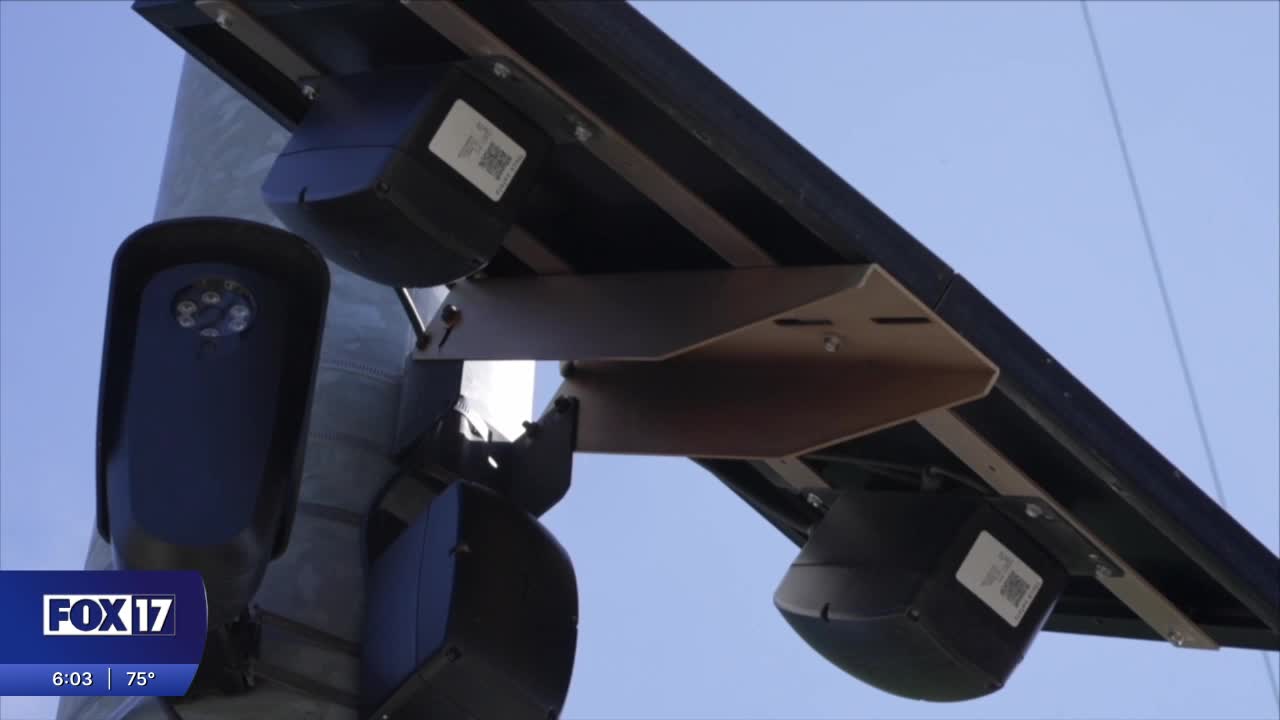


GRAND RAPIDS, Mich. — Grand Rapids police held a briefing Tuesday to address growing community concerns about the city's use of Flock cameras — automated license plate readers developed by Atlanta-based Flock Safety.
Grand Rapids Police Department Chief Joe Trigg welcomed questions about how his department uses the technology, acknowledging the public's unease.
"Technology is scary, especially when it's new," Trigg said. "There was a lot of concern, and rightfully so. I like my privacy as well. I just don't want the government, you know, coming in [for] no reason and watching anything and everything I do either."
Trigg said the department uses the cameras for two purposes only: to locate missing persons and to solve crimes.

Deputy Chief Mike Maycroft explained during Tuesday's Public Safety meeting what GRPD uses Flock for — and what it does not.
The department uses Flock cameras in investigations involving violent crimes, including homicides, criminal sexual conduct, human trafficking, kidnapping, Amber or Silver alerts, stolen vehicles and wanted subjects.
Maycroft said the system does not track or support immigration detainers, warrants or searches; reproductive health-related searches; facial recognition or facial image searches; live camera feeds; audio monitoring or microphone use; or surveillance of private property.

Maycroft described a number of cases in which Flock cameras helped investigators find a murder suspect, locate missing people and solve a shooting.
In one case, a Flock camera placed near an existing surveillance camera helped investigators identify a suspect far more quickly than the surveillance camera alone would have allowed. Maycroft said a man fired a gun into an absentee ballot box, and investigators were able to capture the first character of his license plate from surveillance video.

"After receiving the video, I turned it over to my detectives. They're usually able to use the Flock system to identify a vehicle matching that description. They determined the same individual had been arrested three days later after leaving the same library for drunk driving, and had this firearm on him," Maycroft said.
GRPD conducts monthly audits to ensure officers are not misusing the system. Unless data is saved, the system retains information for 30 days.
The detective sergeant of the Digital Evidence Unit is responsible for overseeing and auditing all license plate searches on a monthly basis. Any non-compliance or misuse would be referred to the Internal Affairs Unit for discipline, up to termination and criminal charges.
Flock Safety Public Affairs Manager Kerry McCormack explained how data sharing works within the platform.
"When you sign up with Flock, you are sharing with no one. From there, you can enter into sharing relationships. Some folks will do regional, some folks will do statewide, and some folks also do national sharing as well," McCormack said.
Flock Safety has contracts with around 6,000 agencies across the country, including approximately 150 in Michigan. Grand Rapids launched a two-year program using 31 cameras at a cost of $165,000.
Trigg said camera placement is guided by traffic patterns and high-volume intersections.
"Some of it has to do with traffic flow. When you're trying to look for plates, you use the technology: what are some busy intersections, what paths are people going to take, or that most traffic is taking," Trigg said.
Despite reporting zero violations in the department's use of the cameras, Trigg said he has no plans to expand the program.
"I understand the questions because it's new technology, but, you know, we have the responsibility to keep this city safe. We've seen the cries and the grief and the violence that can happen in the city. It's still a great city, right? That's still a small amount of folks that are committing these acts, and there's a technology out there that could get accountability for people that commit these crimes," Trigg said.
This story was initially reported by a journalist and has been converted to this platform with the assistance of AI. Our editorial team verifies all reporting on all platforms for fairness and accuracy.

