

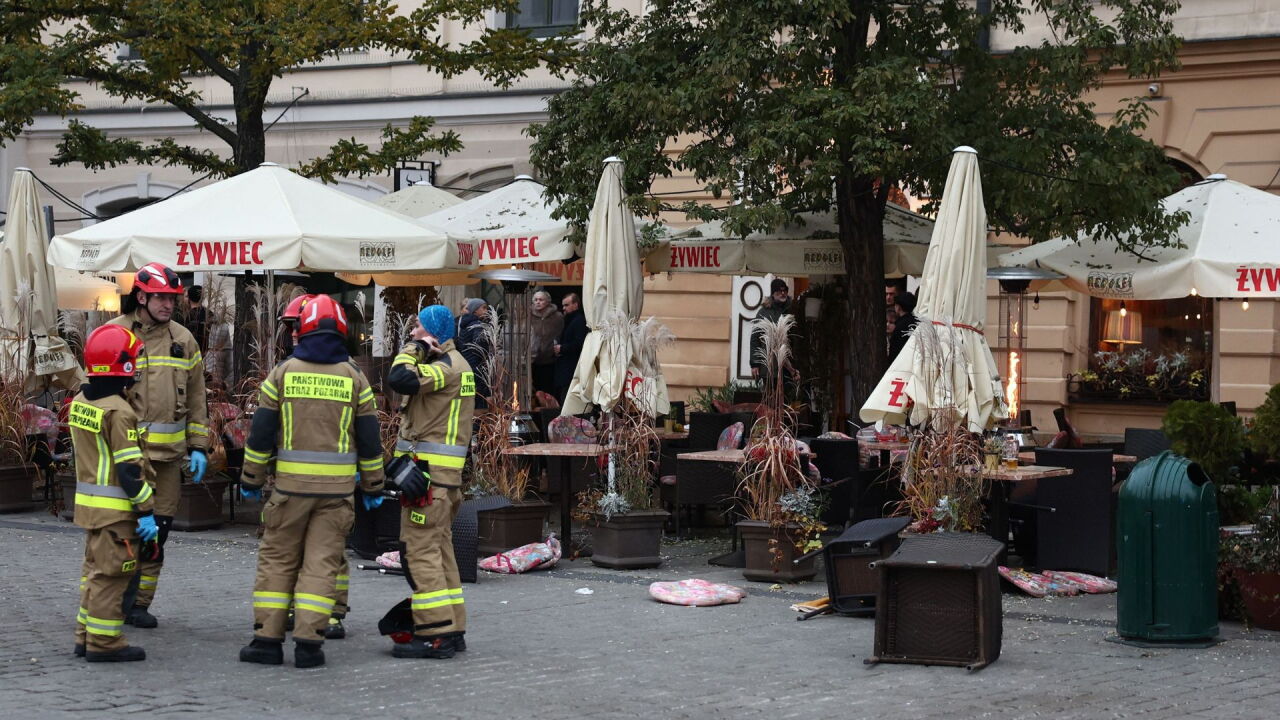

Poland has been left shocked after a rare mass shooting in the country’s south – prompting national mourning and heightened security, as authorities say the attack was likely driven by far-right ideology.
The gunman killed at least six people in Kraków during a deadly rampage in the city’s historic main square on Saturday. Sixteen others were injured.
Three bodies were later found at the suspect’s home in the town of Ostrowiec Świętokrzyski, about 120 miles northeast of Kraków. Police say they were the attacker’s sister, mother and father.
The mass shooting – which authorities said they are investigating as a possible terror attack – has generated a wave of fear in a European nation with exceptionally tight gun laws. One leading Polish daily newspaper, Rzeczpospolita, called the attack a harbinger that “brutally ends an era in which Poland was considered a safe island.”
Police started getting reports of a shooting at around 3 p.m. local time (9 a.m. ET) on Saturday, when the suspect drove into the city’s main market square and started firing randomly, killing four women and two men, Kraków police said.
The alleged attacker was wearing military-style clothing and used “military weapons,” Police Deputy Inspector Katarzyna Cisło told Polish news outlet TVN24. They also found “many pieces of weapons and ammunition” in his vehicle, Cisło added.
The man, a 25-year-old Polish citizen, was shot and injured by police before being transported to the hospital, police said. He underwent multiple surgeries and is in a “stable but very critical condition,” a regional police spokesperson told the Reuters news agency.
He was the only perpetrator sought by authorities.
It’s “highly likely” the killings in the town of Ostrowiec Świętokrzyski and Kraków were carried out by the same person, but investigations are ongoing, the Polish prosecutor’s office said Sunday.
Eleven firearms were recovered from both sites, the prosecutor’s office spokesperson said. That figure aligns with the number of weapons permits issued to the suspect and his father, the spokesperson said.
Poland’s Defense Minister Władysław Kosiniak-Kamysz denied reports that the suspect was a soldier, saying he “never had anything to do with the military.”
Poland, like other European Union countries, has strict rules about acquiring guns and very few people are allowed to own military-style weapons or carry guns in public. About 411,000 people have gun permits in the country, which has a population of more than 37 million, according to the Associated Press.
‘Very radical views’
A quiet mist descended on the city early Sunday as police officers dotted the square, which remained largely cordoned off along with small shops and parallel streets.
The gunman’s motive was not immediately clear, but at a press conference, Interior Minister Marcin Kierwiński said that the shooter was fascinated with far-right ideologies and held “very radical views.”
Two police officers are among those injured in the attack, Kierwiński said. They underwent surgery and are in a stable condition, police said.
The two officers “likely saved many lives, without regard for the risk of losing their own,” Polish Prime Minister Donald Tusk wrote on X.
The injured included five foreign nationals from Austria, Germany, Portugal, Russia and Britain, an Interior Ministry spokesperson told Reuters.
A ‘new era’ of insecurity
Kraków’s main market square, lined with cafes and bars, is typically a busy area that is popular with tourists and locals. The site draws millions of visitors each year, according to Poland’s state broadcaster, TVP.
The city’s transportation agency reported that a bullet from the shooter’s gun struck a tram, shattering the driver’s window, but causing no injuries.
The suspect also shot two horses that were pulling carriages in the city center, according to the animal rights group OTOZ Animals. Both horses are alive, have been treated by a veterinarian, and were taken away from the area, the group said.
Residents in the city recoiled in the aftermath, with many citing increased fears over lack of safety. “This is terrible… That (this) can happen in Poland,” one man, Witold Slowikowshi, told Reuters. “I think that this is a new era in my country.”
Another resident, Malgorzara Pizon, told Reuters she had “goosebumps.”
“For me, it was simply devastating. Just terrible,” she said. “I just can’t comprehend what happened, or why it happened.”
The melody typically played every hour from St. Mary’s Basilica in Kraków’s main square did not ring out overnight in commemoration of those killed – marking the first time the call had been missed since World War II.
Regional governor Krzysztof Klęczar slammed the “immense evil” of Saturday’s events, telling reporters, “We have just gone through a difficult night here in Kraków.”
As reports of the attack swirled online, internet safety officials observed increased disinformation activity, according to the country’s Digital Affairs Minister, Krzysztof Gawkowski. Poland’s Center for Combating Disinformation was catapulted into an “emergency” mode to monitor false and misleading information, Gawkowski posted on X.
“Verified and confirmed information comes exclusively from the authorities and institutions responsible for ensuring safety and establishing the circumstances of this terrible tragedy,” he said.
The President of Poland Karol Nawrocki said “my thoughts are with the victims, those injured and their families.”
Kraków Mayor Łukasz Gibała has declared a period of mourning in the city until November 11. Neighboring countries, including the Czech Republic and Ukraine, have sent messages of condolences.
The-CNN-Wire™ & © 2026 Cable News Network, Inc., a Warner Bros. Discovery Company. All rights reserved.
