

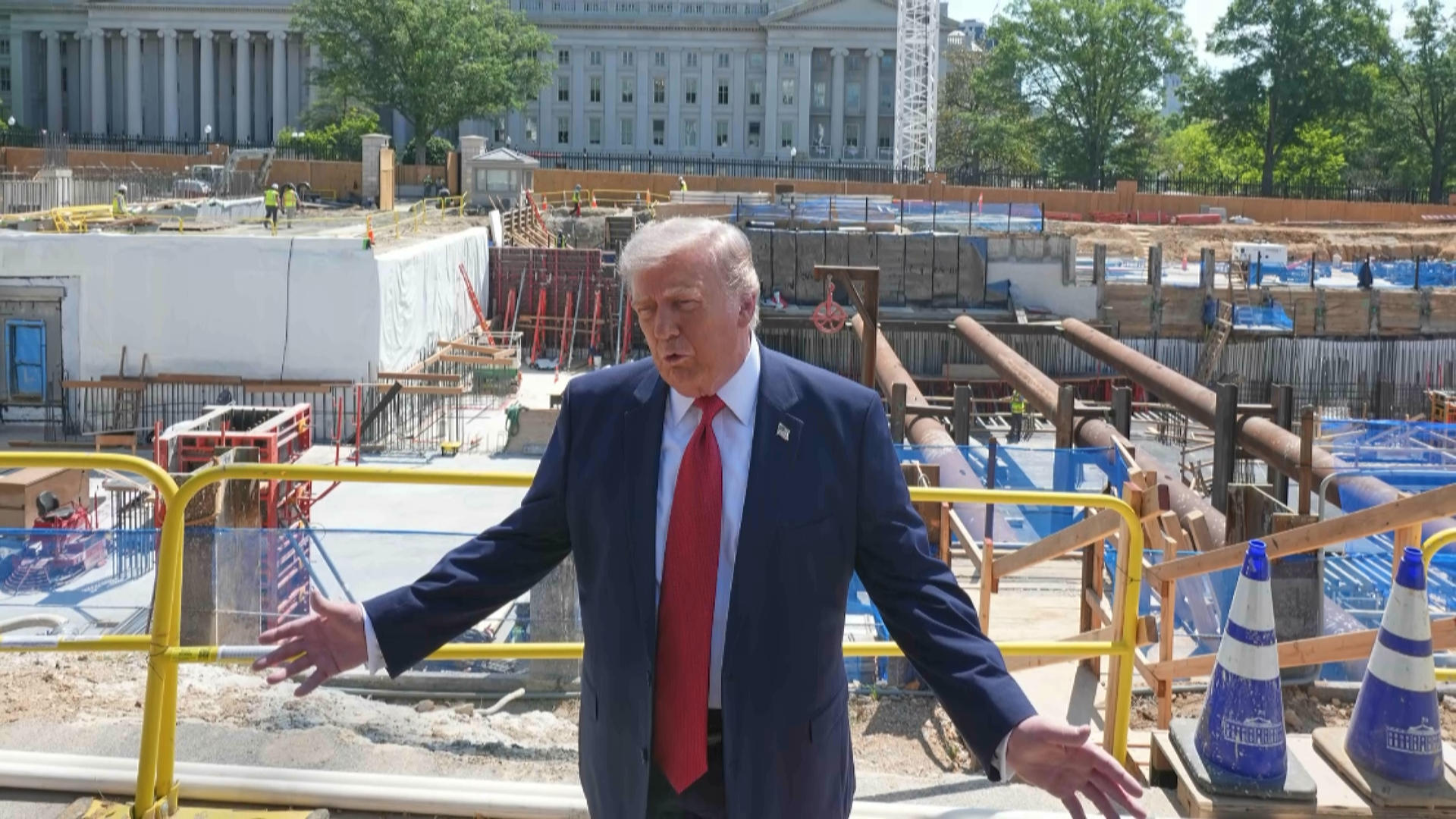


Well before he entered the political realm, President Donald Trump first rose to prominence as a celebrity builder, becoming a household name associated with commercial real estate through his Trump-branded properties and Apprentice television programs.
Decades later – as he navigates a bruising conflict with Iran, stubbornly-high inflation and growing concerns the two may risk Republicans’ chances in the 2026 midterms – Trump has also maintained a significant focus on matters more reminiscent of his early celebrity: the beautification, to his standards, of the nation’s capital, and an unprecedented effort to remake Washington in his own image.
RELATED STORY | Appeals court halts Trump's ballroom project, says Congress must approve it
Since assuming the White House for a second time in 2025, Trump and his administration have pursued changes to more than 100 structures throughout D.C., a Scripps News analysis shows: from high-profile projects like the new White House ballroom and proposed Triumphal arch, to smaller efforts like repainting federal buildings and gilding statues near the National Mall.

“We're bringing back marble columns and restoring classical architecture to our nation's capital to ‘Make America Beautiful Again,’” Trump said at a White House event in March. “D.C. has become really safe and really, really beautiful, and we have some great things planned,” he echoed during a press gaggle on June 9.
“Can’t put a price tag” on D.C. beautification
The total cost of Trump’s beatification efforts remains unclear. During remarks celebrating D.C.’s National Guard deployment at the city’s historic Meridian Hill Park in July – which recently underwent its own multi-million dollar restoration – top White House aide Stephen Miller argued you “can’t put a price tag” on Trump’s improvements to the city.
But early estimates place the total cost for all projects surpassing $1 billion. And despite officials’ repeated claims that improvements sought by the White House will be covered by private donations, federal budget outlays and contracting documents show taxpayers will foot at least some of the bill, to the tune of several hundred million dollars.
Take the proposed White House State Ballroom, for example, among the most prominent and highly-scrutinized projects pursued by the president. Initially estimated to cost about $200 million, officials have since confirmed its cost has more than doubled – with some reports estimating the total investment to be more than $900 million.
Trump and other White House officials have repeatedly insisted the cost of the ballroom will be covered entirely by private donations – Scripps News previously obtained a partial list of some of the individuals and companies making contributions.

Yet several projects associated with the construction appear to be funded using Congressionally-appropriated, taxpayer dollars.
In June, records show White House Office of Management and Budget officials made two transfers, combined worth more than $350 million, from the U.S. Secret Service budget to the ballroom project.
Administration officials have since argued the private donation pledge applies only to the ballroom construction itself, not security upgrades pursued alongside it. Yet some security upgrades at the White House are being privately-funded, including a $6 million helipad for Marine One donated by Lockheed Martin. And other non-security upgrades on White House grounds are being funded with taxpayer monies, including a $7.5 million plan to repaint the Eisenhower Executive Office Building.
Elsewhere throughout the city, meanwhile, the spending continues: at least $257 million for a renovation of the Kennedy Center, $17.4 million for upgrades to Lafayette Park, $5.1 million to gild four statues near the National Mall in 24-karat gold and $16.4 million for a major renovation of the Lincoln Memorial Reflecting Pool – itself the subject of significant controversy.

“Playing fast and loose” with federal contracting guidelines
To some, the Reflecting Pool renovation has become a symbol of the Trump administration’s approach to D.C. beautification. For that project, officials bypassed federal contracting regulations and legally-mandated reviews to fast-track construction, arguing the renovation needed to be completed ahead of the July 4 semiquincentennial celebrations. They subsequently awarded two no-bid contracts to firms with apparent ties to Trump and his businesses.
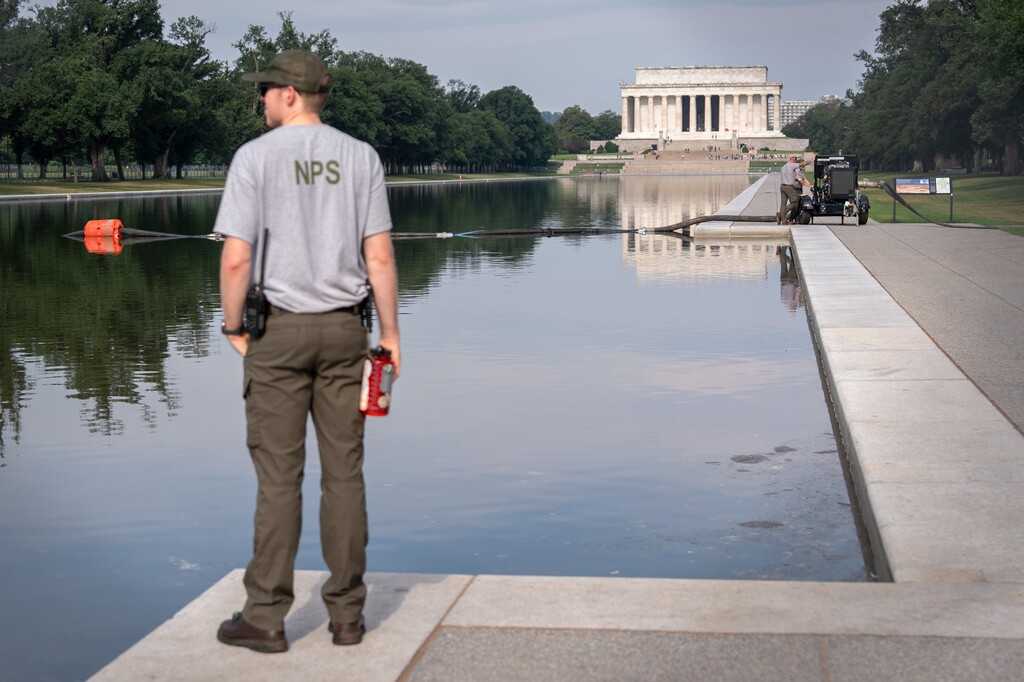
Immediately after the renovation concluded, the pool became rife with algae, and then the new coating began peeling up. Trump and other senior administration officials have claimed such problems were the result of vandalism, charging several individuals for allegedly vandalizing the pool, though all such charges have since been withdrawn as prosecutors admitted in court papers they lacked requisite evidence to support their claims.
RELATED STORY | Trump's push for $1 billion in ballroom and security funds is facing GOP opposition
The pool itself has since been re-drained and is currently surrounded by fencing, as officials consider how to fix the flaws introduced by the renovation. In early August, Trump said the pool would reopen “shortly,” but provided no concrete timeline as to when the repairs would be completed.
In an interview with Scripps News, a former senior official who served in the National Parks Service (NPS) said the Reflecting Pool saga represents just one instance in which the agency is “playing fast and loose” with federal guidelines.
For 15 years, Charles Birnbaum served as the NPS’s coordinator for its Historic Landscape Initiative, helping craft some of the very same guidelines he now says the administration is flouting.
“The Parks Service is acquiescing and they are not being good stewards,” Birnbaum said. “They are actually acting in conflict with their mission and rolling over and not doing their due diligence.”
He now serves as president and CEO of The Cultural Landscape Foundation, a D.C.-based nonprofit organization which earlier this year sued the Trump administration trying to block the Reflecting Pool renovation.
Trump officials are “unapologetic about their aggressiveness, and they're destroying designated properties or visual and spatial relationships,” Birnbaum said.
That lawsuit continues to slowly work its way through the court system, with a judge yet to definitively rule on whether the Trump administration broke the law in pursuing the expedited renovation.
But other legal challenges to D.C. beautification efforts have been more successful.
In early August, the D.C. Circuit Court of Appeals upheld a lower court’s ruling that found Trump’s White House ballroom project was unlawful absent congressional approval.
“Whether or not a massive ballroom should be constructed is for Congress to decide and is not a matter for Executive self-help,” the court wrote in a 2-1 ruling, halting construction of all above-ground structures for the time being.
The Court preemptively stayed its own decision to allow the White House to appeal the order to the U.S. Supreme Court – something administration officials have signaled they intend to do. On Truth Social, Trump decried the judges’ order as “horrendous, politically motivated, and unlawful” and “a National Security threat.”
Funds “funneled” to “Trump’s own backyard”
Beyond the total dollar amount, many questions remain about the source of the money being spent on D.C. beautification efforts – not just whether taxpayer money will be used, but what other projects those funds could have gone towards.
Federal contracting records and statements from Trump administration officials show taxpayer funds have been used or are earmarked for several projects, including the new Eisenhower Executive Office Building paint job and re-gilding of statues near the National Mall.
But many other renovations are relying on funds maintained by the Interior Department from National Parks entrance pass fees – a move that, though legal, has some advocates claiming the White House is neglecting park maintenance in favor of Trump-favored projects.
“We, like many others, have been concerned by the sort of outsized fervor and outsized funds that are seemingly being funneled specifically to spaces like the National Mall, to the White House, and to other places that essentially function as Trump's own backyard,” said Toni Aguilar Rosenthal, program director with the Revolving Door Project (RDP), a government watchdog group that monitors corporate influence and corruption.
A recent RDP analysis found funds from NPS entrance fee accounts were routed to D.C. projects 1,673 percent more during Trump’s second term than they were during the prior two years, as awards to the top ten fee-collecting parks fell 75% during that period.
“Donald Trump seems to believe that our public resources belong to and should serve him, sort of first and foremost,” Aguilar Rosenthal told Scripps News.
In a statement to Scripps News, a spokesperson for the Interior Department said D.C. beautification efforts are being funded through a mix of both “endowment funds” and “revenue brought in from the sale of park passes,” arguing money is being spent not only on beautification efforts surrounding the July 4 celebrations but also “many deferred maintenance projects throughout the country.”
Some such projects were in process before Trump took office, and there are those in Washington who’ve celebrated the president’s focus on the capital region.
But others living in the D.C. area aren’t on board with the administration’s moves.
RELATED STORY | Trump says Pirro 'choked' after DOJ drops reflecting pool vandalism case
“President Trump is kind of just taking carte blanche and changing everything in the landscape of the city,” Anne Culbert, a dental hygienist who lives in Alexandria, Virginia, told Scripps News near the Reflecting Pool one day in June.
“It's hard for folks that don't live in this area,” she continued. “This is my backyard… somebody just needs to say no. Stand up to him.”
