

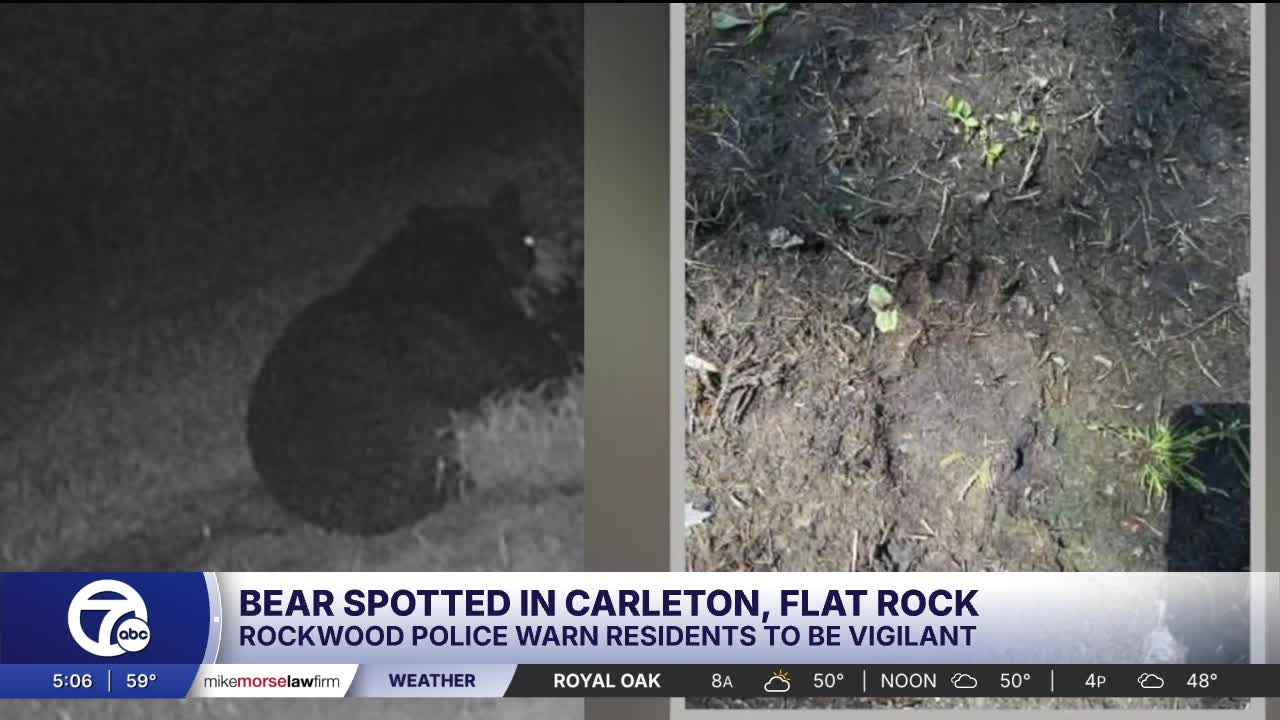


(WXYZ) — It's been more than three months since there were two extremely rare black bear sightings in metro Detroit.
Now, the Michigan Department of Natural Resources is explaining how Michiganders can live with black bears.
Andy Henion, a communications representative for the DNR, said the rare appearance of the black bear in a heavily populated area is a new reality for the state as residents try to live alongside the species.
Watch below: Two black bear sightings reported in Southeast Michigan, DNR confirms
“This may be the farthest southeast a black bear sighting has been confirmed in Michigan,” said DNR wildlife biologist Zach Cooley, who verified the bear’s May 10 visit. “At this point we are not certain how it made its way here. We assume it is probably a young male, wandering.”
According to the DNR, bears once occupied the entire state, but unregulated killing and development in the early 20th century cut down their numbers, especially in the Lower Peninsula. In the Upper Peninsula, it's believed there are nearly 13,000 black bears.
Watch below: Two black bear sightings reported in Southeast Michigan; here's what to know
"Still, in fast-growing and tourist-heavy areas like Grand Traverse County, bears can still cause quite a bit of excitement. In the past six years, the DNR has logged 178 bear complaint reports from Grand Traverse County, by far the most of any county in the northern Lower Peninsula," the DNR wrote.
Jared Duquette, the DNR's human-wildlife interaction specialist, said bears have greater acceptance in communities with long-established populations, like in the UP and northern Lower Peninsula.
“Acceptance depends on several factors, though, such as familiarity with bear behavior, frequency of sightings and how much control people feel they have in interactions with bears,” Duquette said. “In areas where bears are rare, community culture and media coverage can often sway acceptance of bears by sensationalizing their presence and perceived danger.”
In 2008, the DNR developed a black bear management plan, which allows the bear population to expand naturally into the southern Michigan region.
“Bears are likely to become more socially acceptable as they expand south in Michigan,” Duquette said. “However, acceptability will take time and depend on communities building a local culture that understands basic bear behavior and is accepting of bears. Community members should understand that bears are naturally afraid of us and pose little threat to people and pets.”
The black bears are solitary animals, and male bears roam vast areas. Young males may go up to 100 miles to find new and unoccupied territories. While they thrive in forests, they also are adapting to less woodsy areas.
“We’ve been seeing over time that bears continue to survive and persist in habitats that we would not have thought were suitable previously,” said Cody Norton, DNR bear and furbearer specialist. “Bears are extremely adaptable creatures – they are generalists and can make use of a variety of food sources. We’ve been seeing them persist in areas that have very few trees – it may be a little woodlot next to cornfields, for example.”
In the Flint area, bears have shown up, but in urban areas, they have a higher rate of mortality, the DNR said.
“There can be extremely high mortality when bears show up in these older urban environments that are heavily developed with highways running through them,” Norton said.
In the end, the metro Detroit area has some of the state's "least-suitable habitat for bears," the DNR said.
“Could there be pockets in southeast Michigan that if multiple bears made it to, they could persist? Yes, there might be, but I think until we see bears do that, it’s really hard for us to predict whether it’s truly suitable," Norton said.
