

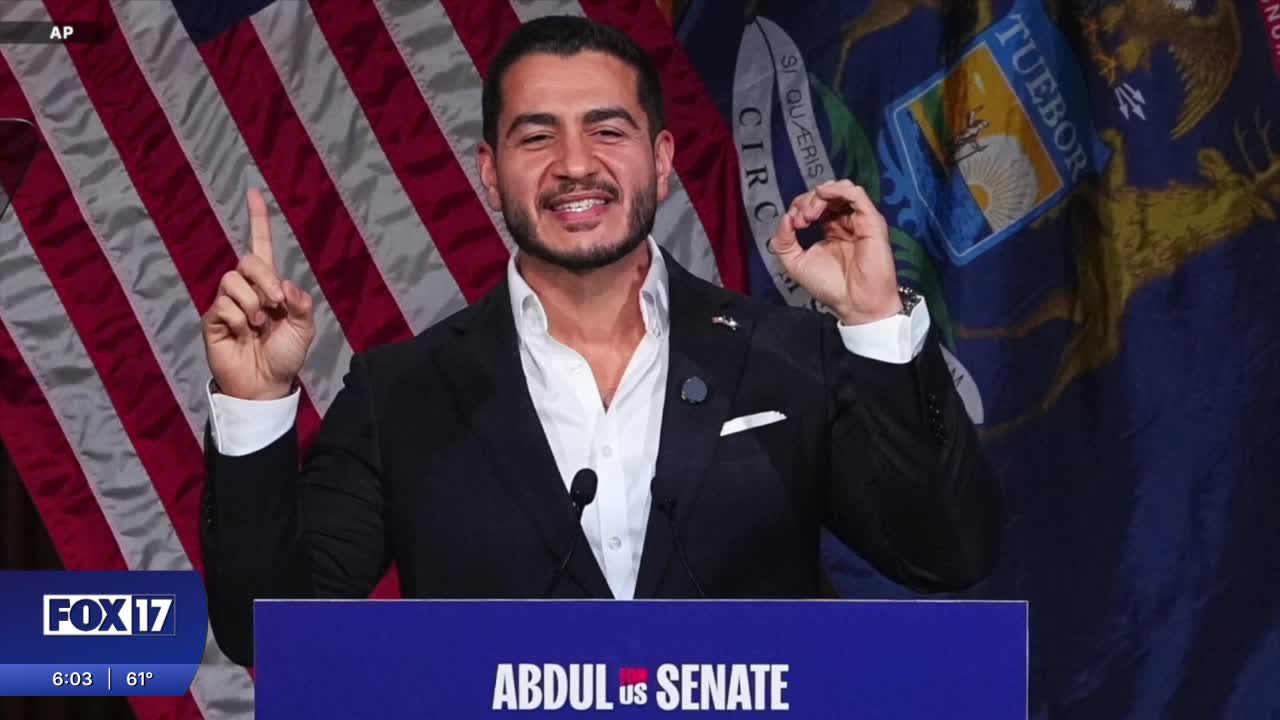



GRAND RAPIDS, Mich. — A day after the midterms, America was awash in a wave of blue.
Those who went to bed on Tuesday before a number of key races across the country were called — including Democrat Abdul El-Sayed's decisive victory over Republican Mike Rogers — awoke to find that control of both the U.S. Senate and House had flipped.
In Michigan, Jocelyn Benson defeated John James, marking the first time the governor's office has been held back-to-back by the same party in decades, and brought with her a Democratic trifecta.
A pair of Republicans who represent the Great Lakes State in the U.S. House were also unseated by Democrats, with Sean McCann beating Rep. Bill Huizenga in Michigan's 4th Congressional District and William Lawrence winning against Rep. Tom Barrett in Michigan's 7th Congressional District.
On Wednesday, I talked to Doug Koopman — a professor emeritus in Calvin University's politics and economics department — about what mattered to voters in the midterms, and what the results said about the state of politics in Michigan.
"A national referendum," Koopman said. "Trump was on the ballot, and people came out to vote and said, 'We don't like this. We don't like the last two years of what we have gotten from this president.'"
While the president's party is liable to lose political ground during their term in office, Koopman said issues of national and international relevance found their way into state and local races, hurting Republicans due to the unpopularity of the current administration.
In Michigan, debate over how to handle relations with Iraq and Israel and a distaste for tariffs on imported goods from Canada played an outsized role in the race between El-Sayed and Rogers, according to Koopman.
"That fed right into the Democratic advantage and the Republican disadvantage," he said.
If Rogers — and James, too — had been able to frame their candidacies as referendums on Gov. Gretchen Whitmer's time in office, they may have fared better in the election, Koopman claimed, but the two were unable to distance themselves from narratives beyond the borders of their own state.
"The leader of their party in Washington wanted this election to be about him," he said.

News
Jocelyn Benson pledges lower costs, transparency after historic election victory
McCann and Huizenga
In Michigan's 4th Congressional District, Sean McCann's win over Bill Huizenga — a victory that may have previously been considered an upset had the Cook Political Report not labeled the race a toss-up in the leadup to the election — proved the strength of the blue wave.
Koopman said there was reason to believe the incumbent could be defeated.
"For more than fifty years, West Michigan has wanted their conservatives and their progressives to be independent," he said.
During his current term, Huizenga "failed" to distinguish himself as West Michigan's and not Washington's in a number of ways, according to Koopman, including by meeting with President Trump to discuss a U.S. Senate bid.
Meanwhile, McCann had put together an "established" record in the state senate.
"So, it was an ideal candidate for the Democrats, a very difficult running situation for a Republican, and a couple of sort of missteps — a misreading and a misremembering the history of Western Michigan and what voters like to see in their politicians," Koopman said.

Local News
McCann looks ahead after victory in Michigan’s 4th Congressional District
What now?
I asked Koopman how voters would reflect on these midterms in a year or in a decade.
"When you bounce around every two years from a big win to a big loss or from a big loss to a big win, depending on your party, that's a sense that the middle is frustrated," he said. "We'll either say, 'Wow, they finally got it,' or we'll say, 'It was just one more election in the cycle of flipping power from one party to the other.'"
Voters in Michigan
On Wednesday, I also spoke to a pair of voters who, like a majority of Michiganders, voted for Democrats in the midterms.
"I think the working class in Michigan finally hit that wall," said Bob Smith, the chair of the UAW Community Action Program in West Michigan. "We want something different."
Smith, too, found the election to be a referendum on the president.
"He made a point of making the election about him, constantly saying, 'Vote like I'm on the ballot.' Well, I did.'"
If Miguel Diaz had a direct line to those whom he helped elect to their new offices, he'd tell them to "get to work" and make decisions "based on what is right for the people, regardless of how they voted."
"We have to have that unified message," Diaz said. "The competition is over. Let's go back to being people again."
